

三、推进全球治理事业的中国贡献
III. China’s Contribution to Promoting Global Governance
中国作为负责任大国,高举构建人类命运共同体旗帜,带头践行真正的多边主义,始终不渝做世界和平的建设者、全球发展的贡献者、国际秩序的维护者、公共产品的提供者,积极推动构建更加公正合理的全球治理体系。
As a responsible major country, China champions the building of a community with a shared future for humanity and takes the lead in practicing true multilateralism. It has consistently been a builder of world peace, a contributor to global development, a defender of the international order, and a provider of public goods, while actively advancing the efforts for building a more just and equitable global governance system.
(一)致力于普遍安全、共同安全
1. Committing to Universal and Common Security
人类是不可分割的安全共同体。作为在和平与安全问题上纪录最好的大国,中国把坚持走和平发展道路写入宪法,倡导共同、综合、合作、可持续的安全观,提出并践行全球安全倡议,为实现世界长治久安贡献力量。
Humanity forms an indivisible community of security. As a major country with the best peace and security record, China has enshrined in its Constitution a commitment to peaceful development. It champions the vision of common, comprehensive, cooperative, and sustainable security, and has put forward the Global Security Initiative and acted on its principles, contributing to lasting world peace and stability.
在联合国框架下坚定维护世界和平。中国忠实履行安理会常任理事国职责和使命,坚定支持联合国在国际事务中发挥核心作用,支持安理会在和平与安全问题上发挥首要作用。积极参与联合国维和行动,是联合国维和行动第二大出资国、安理会常任理事国第一大出兵国,迄已派出维和人员5万余人次,参加29项安理会授权的联合国维和行动,组建8000人规模的维和待命部队,率先组建全球首支成建制常备维和警队。2025年9月3日,中国作为第二次世界大战主要战胜国,隆重纪念中国人民抗日战争暨世界反法西斯战争胜利80周年,同国际社会一道捍卫二战胜利成果,弘扬正确二战史观,发出守护和平、正义必胜的时代强音。
Firmly safeguarding world peace within the framework of the UN. China faithfully fulfills its mission and duties as a permanent member of the UN Security Council, firmly supporting the UN in playing its core role in international affairs and the Security Council in playing its primary role in international peace and security. China also takes an active part in UN peacekeeping operations as the second largest contributor to the UN peacekeeping budget and the largest troop contributor among the permanent members of the UN Security Council. To date, more than 50,000 Chinese peacekeepers have been dispatched in 29 peacekeeping operations authorized by the UN Security Council. The country has also established the world’s first standing peacekeeping police unit and maintains a peacekeeping standby force of 8,000 troops.
On September 3, 2025, China celebrated the 80th anniversary of its victory in the Chinese People’s War of Resistance Against Japanese Aggression and the World Anti-Fascist War. Together with the international community, China will safeguard the victory of World War II, promote a correct understanding of that war, and send the powerful message that peace must be safeguarded and justice will prevail.
维护全球战略稳定。中国奉行防御性的国防政策,恪守不首先使用核武器政策,坚持自卫防御核战略,坚定维护国际核裁军和核不扩散体系。推动五核国领导人共同发表关于防止核战争与避免军备竞赛的联合声明,重申“核战争打不赢也打不得”理念,强调避免军事对抗、防止军备竞赛,发出了维护全球战略稳定、减少核冲突风险的共同声音。中国提出公正、合作、平衡、有效的军控理念,支持以联合国为核心的国际军控体系。
Maintaining global strategic stability. China pursues a national defense policy that is in nature defensive, upholds a firm commitment to a policy of no-first-use of nuclear weapons and a nuclear strategy of self-defense, and resolutely safeguards the international nuclear disarmament and nonproliferation regimes. It promoted the issuance of a joint statement of the leaders of the five nuclear-weapon states on preventing nuclear war and avoiding arms races, reiterating the view that a nuclear war cannot be won and must never be fought, emphasizing the need to avoid military confrontation and prevent arms races and articulating a shared commitment to maintaining global strategic stability and reducing the risk of nuclear conflicts. China has put forward the principles of justice, cooperation, balance and effectiveness in arms control, and upholds the international arms control regime with the UN at its core.
开创中国特色热点问题解决之道的成功实践。中国主张坚持不干涉内政、坚持政治解决、坚持客观公正、坚持标本兼治,提供了建设性解决热点问题的新选择。在乌克兰危机上,以“四个应该”①为根本遵循,发布《关于政治解决乌克兰危机的中国立场》文件,会同巴西等全球南方国家发起乌克兰危机“和平之友”小组,为止战和谈汇聚合力、积累条件。在巴以问题上,推动安理会通过新一轮巴以冲突爆发后的首份加沙停火决议,向加沙提供紧急人道主义援助,旗帜鲜明支持“两国方案”,推动巴勒斯坦问题全面、公正、持久解决。促成沙特和伊朗历史性和解并复交,巴勒斯坦14个派别来华举行和解对话并签署《北京宣言》,中东“和解潮”深受欢迎。就维护和促进中东和平稳定提出坚持和平共处原则、坚持国家主权原则、坚持国际法治原则、坚持统筹发展和安全四点主张,同巴基斯坦共同发表关于恢复海湾和中东地区和平稳定的五点倡议。倡导安危与共、求同存异、对话协商的亚洲安全模式,促成缅北冲突相关方签署停火协议,就柬泰边境争端、阿巴冲突等发挥建设性作用。提出“非洲之角和平发展构想”,支持地区国家应对安全挑战。
Pioneering the use of a unique Chinese approach to addressing international flashpoints. China upholds the principles of non-interference in other countries’ internal affairs, political settlement of issues, objectivity and fairness, and addressing both symptoms and root causes, offering a new approach for finding constructive solutions to flashpoints.
On the Ukraine crisis, China follows the four key principles[The principles are: The sovereignty and territorial integrity of all countries should be upheld; the purposes and principles of the UN Charter should be observed; the legitimate security concerns of all parties should be taken seriously; all efforts conducive to the peaceful settlement of the crisis should be supported.]as its fundamental guide. It released China’s Position on the Political Settlement of the Ukraine Crisis and, together with Brazil and other Global South countries, launched the Group of Friends for Peace on the Ukraine crisis, building synergy and creating conditions for ceasefire and peace talks.
On the Palestinian-Israeli conflict, China has urged the UN Security Council to pass the first ceasefire resolution for Gaza since the outbreak of a new round of conflict. It has provided emergency humanitarian assistance to Gaza and taken a clear stand in support of the two-state solution, promoting a comprehensive, just, and lasting resolution of the Palestinian question.
China has facilitated the historic reconciliation and restoration of diplomatic relations between Saudi Arabia and Iran, and 14 Palestinian factions visited China for reconciliation talks and signed the Beijing Declaration on Ending Division and Strengthening Palestinian National Unity. This wave of reconciliation in the Middle East has been widely welcomed. In promoting peace and stability in the Middle East, China has put forward the principles of peaceful coexistence, national sovereignty, international rule of law, and a holistic approach to development and security. Together with Pakistan, China has issued a five-point initiative of China and Pakistan for restoring peace and stability in the Gulf and Middle East Region.
Championing an Asian security model characterized by security for all, common ground amid differences, and dialogue and consultation, China has facilitated a ceasefire agreement between conflicting parties in northern Myanmar and played a constructive role in the border dispute between Cambodia and Thailand and the cross-border clashes between Afghanistan and Pakistan. It has proposed the Outlook on Peace and Development in the Horn of Africa, supporting countries in the region in responding to security challenges.
筑牢非传统安全屏障。持续支持全球公共安全合作论坛(连云港)建设,凝聚各方共识,推动全球公共安全治理。中国主张综合施策、标本兼治,推进国际和区域反恐合作,落地上海合作组织应对安全威胁与挑战综合中心及其信息安全中心、打击跨国有组织犯罪中心以及禁毒中心,积极帮助发展中国家加强反恐能力建设。坚决打击跨国毒品犯罪,引领大湄公河次区域、上海合作组织和金砖国家禁毒合作务实开展,在世界上率先整类列管芬太尼类物质。有力打击网赌电诈等跨境犯罪,加快推进国际打击电信网络诈骗联盟建设,同泰国、缅甸、老挝等国联合捣毁一大批境外诈骗窝点。在二十国集团框架下提出国际粮食安全合作倡议,推动通过《金砖国家粮食安全合作战略》,加入“抗击饥饿与贫困全球联盟”,向多个粮食短缺或遭遇灾害的国家提供紧急人道主义粮食援助。
Reinforcing non-traditional security shields. China continues to support the development of the Global Public Security Cooperation Forum (Lianyungang) to build consensus among all parties and advance global public security governance. China advocates comprehensive measures for addressing both symptoms and root causes, and promotes international and regional counter-terrorism cooperation. It has facilitated the establishment of the Integrated Center for Countering Security Threats and Challenges of the Shanghai Cooperation Organization (SCO) and its Center for Combating Transnational Crime and Information Security Center, and the SCO Narcotics Control Center, playing an active role in helping other developing countries reinforce their counter-terrorism capacities.
In resolutely cracking down on transnational drug trafficking, China leads pragmatic anti-drug cooperation operations in the Greater Mekong Subregion and by the SCO and BRICS countries, and has taken the global lead in scheduling the whole class of fentanyl-related substances. It has combated cross-border crimes such as online gambling and telecom fraud, accelerated the development of an international alliance on combating telecom fraud, and dismantled large groups of overseas scam centers in cooperation with countries including Thailand, Myanmar, and Laos. China has proposed the International Cooperation Initiative on Global Food Security within the framework of G20, facilitated the adoption of the BRICS Strategy on Food Security Cooperation, joined the Global Alliance Against Hunger and Poverty, and provided emergency humanitarian food assistance to multiple countries suffering food shortages or disasters.
(二)促进开放合作、共同发展
2. Promoting Openness, Cooperation, and Common Development
中国的发展离不开世界,世界的繁荣也需要中国。作为最大的发展中国家,中国始终将自身发展置于人类发展的坐标系,坚持开放共赢、倡导普惠包容,以中国式现代化为世界提供新机遇,促进世界各国现代化的发展潮流。
China cannot develop in isolation from the rest of the world, nor can the world achieve overall prosperity without China. As the largest developing country, China has always pursued its own growth in the context of humanity’s shared development and upheld openness, win-win cooperation, inclusiveness, and shared benefits. Through Chinese modernization, the country has provided the world with new opportunities and boosted the global drive for modernization.
推动建设开放型世界经济。中国坚持推动贸易和投资自由化便利化,已经成为160多个国家和地区的主要贸易伙伴,同31个国家和地区签署了24个自贸协定。推动达成并高水平实施《区域全面经济伙伴关系协定》,签署中国-东盟自贸区3.0版升级议定书,积极推进加入《全面与进步跨太平洋伙伴关系协定》和《数字经济伙伴关系协定》,扩大面向全球的高标准自由贸易区网络。坚定维护以世界贸易组织为核心、以规则为基础的多边贸易体制,全面深入参与世贸组织改革,宣布在世贸组织当前和未来谈判中不寻求新的特殊和差别待遇。
Contributing to building an open global economy. China has promoted trade and investment liberalization and facilitation, and it has become the main trading partner of over 160 countries and regions, signing 24 free trade agreements with 31 countries and regions in the process. It has facilitated and achieved high-standard implementation of the Regional Comprehensive Economic Partnership (RCEP) and signed the China-ASEAN Free Trade Area 3.0 Upgrade Protocol. It endeavors actively to join the Comprehensive and Progressive Agreement for Trans-Pacific Partnership (CPTPP) and the Digital Economy Partnership Agreement (DEPA) to expand the globally-oriented network of high-standard free trade areas. The country firmly safeguards the rule-based multilateral trading system with the World Trade Organization (WTO) at its core, engages fully and deeply in WTO reforms, and has announced that it will not seek new special and differential treatment in current and future negotiations at the WTO.
以更高水平对外开放为世界带来更广阔机遇。深入推进制度型开放,全面取消制造业领域外资准入限制措施,持续缩减外资准入负面清单,打造市场化法治化国际化一流营商环境。有序扩大自主开放和单边开放,先后设立23个自贸试验区,海南自由贸易港全岛封关运作,积极打造中国国际进口博览会、中国国际服务贸易交易会、中国国际消费品博览会、中国国际供应链促进博览会等开放合作平台,对所有建交的最不发达国家和非洲国家实施零关税。中国“十四五”时期货物和服务进口超过15万亿美元,未来五年中国国内生产总值有望从140万亿元增长至170万亿元人民币,超大规模市场潜力不断释放。
Bringing broader opportunities to the world with higher-standard opening up. China has expanded institutional opening up, removed all restrictions on foreign investment access in the manufacturing sector, continued to shorten the negative list for foreign investment, and fostered a world-leading business environment that is based on market principles, governed by law, and up to international standards. Steps have been taken to expand voluntary and unilateral opening up, with the launch of 23 pilot free trade zones, island-wide special customs operations in the Hainan Free Trade Port, and open platforms such as the China International Import Expo, China International Fair for Trade in Services, China International Consumer Products Expo, and China International Supply Chain Expo. Additionally, zero tariffs have been placed on the least developed countries and African countries that have established diplomatic relations with China. During the 14th Five-year Plan period (2021-2025), China’s imports of goods and services exceeded US$15 trillion, and its GDP is expected to increase from RMB140 trillion to RMB170 trillion in the next five years, as its vast market continues to realize its potential.
高质量共建“一带一路”走深走实。中国推动共建“一带一路”进入高质量发展新阶段,打造了范围最广、规模最大的国际合作平台,拓宽了造福世界的“发展带”、惠及各方的“幸福路”。政策沟通汇聚合力,同150多个国家、30多个国际组织签署合作文件,成功举办三届“一带一路”国际合作高峰论坛,在经贸、能源、基础设施等重点领域建立30多个专项合作机制,成立高峰论坛秘书处。设施联通跨越发展,一大批跨境公路、铁路、港口和航空枢纽等旗舰项目取得新突破,“六廊六路多国多港”的互联互通架构基本形成,中欧班列累计开行突破13万列。贸易畅通逆势推进,跨境支付、数字认证、智慧海关等领域制度深入对接,2025年中国同共建国家货物贸易额达到23.6万亿元人民币,同比增长6.3%,占中国对外贸易总额的比重提升到51.9%。资金融通日益多元,亚洲基础设施投资银行、丝路基金已为数百个项目提供投融资支持,设立人民币融资窗口,2021年至2025年上半年中国与共建国家双向投资累计超过2400亿美元。民心相通更加紧密,鲁班工坊、菌草技术等标志性民生品牌持续推进,文化、旅游、教育、媒体、青年等交流合作百花齐放。
Achieving solid progress in deepening high-quality Belt and Road cooperation. China has promoted cooperation in the Belt and Road Initiative (BRI) to a new stage of high-quality development. It has established the world’s broadest and largest international cooperation platform and expanded the belt of development and road to happiness to benefit all parties.
Policy connectivity has built greater synergy. China has signed cooperation documents with over 150 countries and 30 international organizations, hosted three Belt and Road forums for international cooperation, established more than 30 special cooperation mechanisms in key areas such as economy, trade, energy and infrastructure, and established a secretariat for the forum.
Infrastructure connectivity has achieved leapfrog development. Flagship programs such as cross-border highways, railways, ports, and aviation hubs have made breakthroughs, and a general connectivity framework consisting of six corridors, six connectivity routes, and multiple countries and ports has now been realized. The China-Europe Railway Express freight service has operated more than 130,000 trips to date.
Trade connectivity has advanced despite challenges. In-depth alignment has been achieved in areas such as cross-border payments, digital authentication, and smart customs. In 2025, the volume of trade in goods between China and BRI participants reached RMB23.6 trillion, up by 6.3 percent year-on-year, accounting for 51.9 percent of the country’s foreign trade.
Financial connectivity has embraced greater diversity. The Asian Infrastructure Investment Bank (AIIB) and the Silk Road Fund have provided financing support to hundreds of projects. Renminbi financing windows have been set up, and the two-way investment between China and its BRI partners totaled more than US$240 billion between 2021 and the first half of 2025.
People-to-people connectivity has become stronger. Landmark livelihood initiatives supported by Luban Workshops and Juncao technology have continued to advance, and communication and exchange have flourished in culture, tourism, education, and media, as well as between the youth of different nations.
全球发展倡议落地见效。中国以加快落实联合国2030年可持续发展议程为目标,推动全球发展迈向平衡协调包容新阶段,实现更加强劲、绿色、健康的全球发展。发展优先的共识持续凝聚,130多个国家和国际组织支持参与倡议,80多个国家加入“全球发展倡议之友小组”,中国主持召开全球发展高层对话会,举办全球共享发展行动论坛,推动各方对可持续发展目标再承诺、再出发。合作机制日趋完善,中国同发展中国家、国际组织和金融机构签署80多份落实倡议合作文件,在倡议八大重点领域搭建30余个合作机制、全面覆盖所有17项可持续发展目标,成立全球发展促进中心,建立全球发展知识网络,发布《全球发展报告》。与联合国建立中国-联合国全球南南发展支持机制,同联合国开发计划署积极商谈筹建开发计划署全球可持续发展中心,主动设立全球发展学院。发展合作资源不断汇聚,动员各类发展资金230多亿美元,创设全球发展和南南合作基金并增资至40亿美元,启动中国-联合国粮农组织第三期南南合作信托基金。务实合作成效显著,中国设立全球发展倡议项目库,开展了1800多个合作项目,倡议框架下完成8万人次研修培训,助力发展中国家提升自主和可持续发展能力。
Delivering effective results in implementing the Global Development Initiative. To accelerate the realization of the UN 2030 Agenda for Sustainable Development, China helps steer global development towards a new stage of balanced, coordinated and inclusive growth that delivers more robust, greener, and healthier global development.
Consensus on development as a priority continues to build, with more than 130 countries and international organizations supporting participation in the initiative and over 80 countries joining the Group of Friends of the Global Development Initiative. China has hosted the High-Level Dialogue on Global Development and the Forum on Global Action for Shared Development, encouraging all parties to make new commitments to and embark on a new journey towards realizing the Sustainable Development Goals.
Cooperation mechanisms continue to improve. China has signed more than 80 cooperation documents on implementing the initiative with other developing countries, international organizations, and financial institutions. Over 30 cooperation mechanisms have been established in eight key areas of the initiative, covering all 17 sustainable development goals. China has also set up a Global Development Promotion Center and a Global Knowledge Network for Development, and issued the Global Development Report. Together with the UN, it has established the China-UN Global South-South Development Facility, actively discussed the development of the Global Center for Sustainable Development in cooperation with the United Nations Development Programme, and taken the initiative to establish the Institute of Global Development.
Resources for development cooperation continue to grow. More than US$23 billion of development funds of various types have been mobilized. China has established the Global Development and South-South Cooperation Fund, increased its total to US$4 billion, and launched the China-FAO South-South Cooperation Trust Fund (Phase III).
Pragmatic cooperation has delivered remarkable results. China has established a project pool under the Global Development Initiative, launched more than 1,800 cooperation projects, and completed the training of 80,000 people within the framework of the initiative, assisting other developing countries in improving their capacity for independent and sustainable development.
(三)坚定践行真正的多边主义
3. Practicing True Multilateralism
无论国际风云如何变化,中国始终坚定维护以联合国为核心的国际体系、以国际法为基础的国际秩序、以联合国宪章宗旨和原则为基础的国际关系基本准则,倡导和践行真正的多边主义,坚定做多边合作的积极引领者、有力推动者。
No matter how the world changes, China will always uphold the international system with the United Nations at its core, the international order underpinned by international law, and the basic norms governing international relations based on the purposes and principles of the UN Charter. It advocates and practices true multilateralism and remains an active champion and strong proponent of multilateral cooperation.
坚定维护联合国权威和地位。中国是联合国创始会员国,是第一个在联合国宪章上签字的国家,始终以实际行动维护联合国在国际事务中的核心作用。中国承担的联合国会费比例从2000年的不到1%增长到2025年的20%以上,成为联合国常规预算的第二大出资国,足额缴纳联合国会费摊款,支持联合国机构有效运转。设立中国-联合国和平与发展基金并予以续期、加大投入,有力支持联合国重大议程。中国支持联合国推进落实《未来契约》、通过“联合国80周年改革倡议”提质增效,重振活力。积极支持联合国及其专门机构在华设立新机构,在上海设立联合国教科文组织国际STEM(科学、技术、工程和数学)教育研究所、国际货币基金组织上海区域中心。向联合国输送优秀人才,中国籍职员在联合国各机构和相关国际组织中的比例稳步提升。成功举办全球妇女峰会,加速妇女全面发展新进程。
Resolutely upholding the authority and status of the UN. As a founding member of the UN and the first country to sign the UN Charter, China has consistently upheld the central role of the UN in international affairs through concrete actions. The country’s contribution to the UN regular budget increased from less than 1 percent in 2000 to over 20 percent in 2025, making it the second largest contributor. It has paid in full its assessed contributions to the UN in support of the effective operation of UN agencies. It has launched and renewed the China-UN Peace and Development Fund and increased its input to the fund, providing strong support to major UN agendas.
China supports the UN in advancing the implementation of the Pact for the Future and in enhancing the quality, efficiency, and vitality of the organization through the UN80 Initiative. It actively supports the UN and its specialized agencies in establishing new institutions in China, including the UNESCO International Institute for STEM Education in Shanghai and the International Monetary Fund (IMF) Shanghai Center. China’s efforts to supply outstanding talent to the UN have led to a steady increase in the share of Chinese employees in UN agencies and related international organizations. China has hosted the Global Leaders’ Meeting on Women, boosting new progress in women’s well-rounded development.
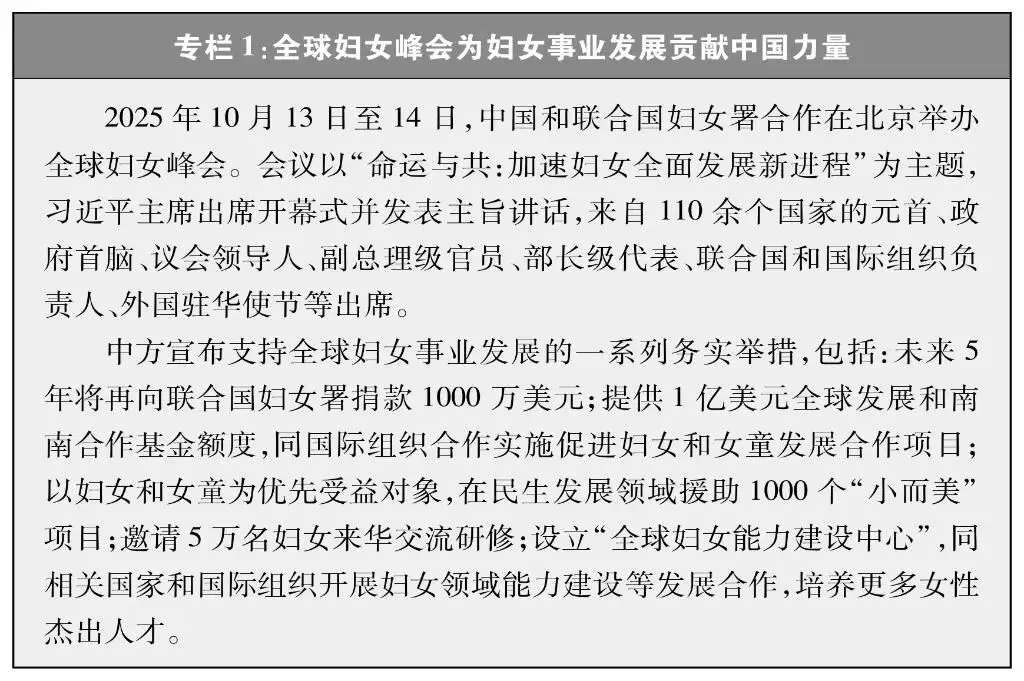
Panel 1 Global Leaders’ Meeting on Women: China’s Contribution to the Development of Women’s Cause
From October 13 to 14, 2025, China and UN Women jointly hosted the Global Leaders’ Meeting on Women in Beijing. Under the theme of “One Shared Future: New and Accelerated Process for Women’s All-Round Development”, the summit was attended by guests from over 110 countries, including heads of state and government, heads of parliament, officials at the vice-premier level, representatives at the ministerial level, representatives of UN agencies and international organizations, and diplomatic envoys. China’s President Xi Jinping attended the opening ceremony and delivered a keynote speech.
To further support the global cause of women, China announced that in the next five years it would donate a further US$10 million to UN Women, earmark a quota of US$100 million in China’s Global Development and South-South Cooperation Fund for implementing development cooperation projects for women and girls in collaboration with international organizations, and launch 1,000 small and beautiful livelihood programs with Chinese assistance, prioritizing women and girls as the primary beneficiaries. At the same time, it would invite 50,000 women to China for training and exchange programs and establish a Global Center for Women’s Capacity Building aimed at conducting capacity building and cooperation for women’s development with relevant countries and international organizations to train more female talent.
维护国际法治权威,促进国际法治进步。中国加入了几乎所有普遍性政府间国际组织,参加了600多项国际公约及修正案,善意履行条约义务,切实兑现国际承诺。隆重举行和平共处五项原则发表70周年纪念大会,坚定捍卫国际关系基本准则和国际法基本原则。坚定支持联合国司法机构工作,积极参加国际司法活动。积极开展国际执法合作,不断加大在反腐败、境外追逃追赃等方面的遣返和引渡力度。发起并推动建立国际调解院,填补了国际调解领域机制的空白。
Upholding the authority of the international rule of law and pushing for progress in international law-based governance. China has joined nearly all universal intergovernmental organizations and signed over 600 international conventions and amendments, fulfilling its treaty obligations in good faith and honoring its international commitments. The country held a conference marking the 70th anniversary of the Five Principles of Peaceful Coexistence, reaffirming and safeguarding the basic norms governing international relations and the principles of international law. China continues to provide firm support for the work of UN judicial bodies and remains an active participant in international judicial activities. Engaging in international law enforcement cooperation, it has increased efforts in anti-corruption action, the cross-border pursuit of fugitives, their repatriation and extradition, and recovery of assets. Additionally, it has initiated and led the creation of the International Organization for Mediation, filling a gap in the international mediation mechanism.
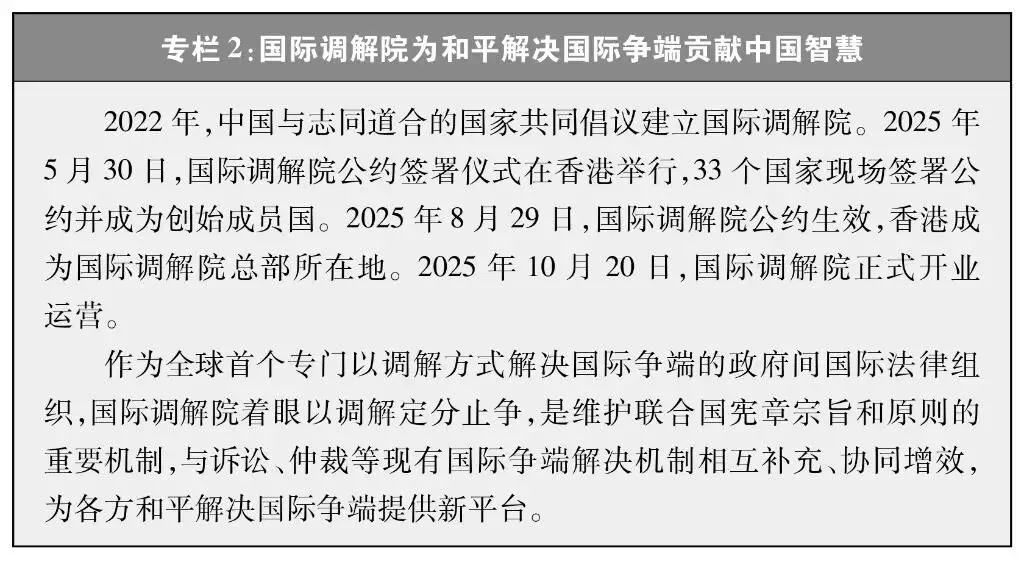
Panel 2 International Organization for Mediation: Chinese Wisdom for the Peaceful Settlement of International Disputes
In 2022, China and like-minded countries initiated the establishment of the International Organization for Mediation (IOMed). On May 30, 2025, the signing ceremony of the Convention on the Establishment of the International Organization for Mediation was held in Hong Kong, with 33 countries signing the convention and becoming its founding members. On August 29, 2025, the convention entered into force, with Hong Kong becoming the location of IOMed’s headquarters. On October 20, 2025, the organization commenced formal operations.
As the first intergovernmental legal organization dedicated to resolving international disputes through mediation, the IOMed focuses on mediating disputes to resolve conflicts and serves as an important mechanism that safeguards the purposes and principles of the UN Charter. It complements and creates synergy with litigation, arbitration, and other existing mechanisms to resolve international disputes, and provides a new platform for their peaceful settlement.
参与并引领二十国集团合作。中国推动二十国集团以平等协商、互利共赢精神引领国际合作,建设好这一发达国家和发展中国家协商国际经济事务、开展国际经济合作的主要论坛。举办二十国集团历史上成果最为丰富的2016年杭州峰会,发表具有里程碑意义的领导人公报,首次将发展议题置于宏观经济政策协调中心位置,核准《二十国集团全球投资指导原则》《二十国集团创新增长蓝图》等多份共识文件,在二十国集团发展进程中留下鲜明的中国印记。在二十国集团领导人里约峰会上,系统阐述全球经济、金融、贸易、数字、生态治理重大主张,推动建设合作型、稳定型、开放型、创新型、生态友好型世界经济。中国率先公开支持非盟加入二十国集团,推动提升发展中国家代表性。
Participating in and leading G20 cooperation. China encourages the G20 – as a major forum for economic dialogue between developed and developing countries – to pursue international cooperation in the spirit of equal consultation and mutual benefit. In 2016, China hosted the G20 Hangzhou Summit, widely regarded as one of the most fruitful G20 summits to date. It issued what became a landmark G20 Leaders’ Communiqué, put development at the center of macroeconomic policy coordination for the first time, and endorsed consensus documents such as the G20 Guiding Principles for Global Investment Policymaking and G20 Blueprint on Innovative Growth, leaving China’s clear imprint in the group’s history. During the G20 Summit in Rio de Janeiro, China set out its proposals for economic, financial, trade, digital, and ecological governance, promoting a world economy built on cooperation, stability, openness, innovation, and eco-friendliness. China also took the lead in supporting the African Union’s membership in the G20 to increase the representation of developing countries.
推进亚太共同体建设。亚太经济合作组织是亚太地区层级最高、领域最广、影响力最大的经济合作机制。中国积极倡导秉持亚太大家庭精神,致力于推动构建开放包容、创新增长、互联互通、合作共赢的亚太命运共同体。在中方推动下,2001年亚太经合组织上海会议通过《上海共识》,新世纪亚太合作再出发;2014年亚太经合组织北京会议达成《北京纲领》等多项重要成果,各方承诺构建面向未来的亚太伙伴关系,为地区长远发展和共同繁荣勾画了愿景。2026年,中国第3次担任亚太经合组织东道主,把“建设亚太共同体,促进共同繁荣”确定为会议主题,聚焦“开放、创新、合作”三大优先领域,携手各方重温亚太合作初心,推动亚太共同体建设从目标转向行动,从蓝图走向现实。
Advancing an Asia-Pacific community. The Asia-Pacific Economic Cooperation (APEC) is the highest-level mechanism for economic cooperation in the Asia-Pacific region, with the broadest coverage and greatest influence. China advocates the spirit of an Asia-Pacific family and promotes an Asia-Pacific community of shared future characterized by openness and inclusiveness, innovation-driven growth, greater connectivity, and mutually beneficial cooperation. Facilitated by China, the Shanghai Accord of the APEC Economic Leaders’ Declaration was adopted at the APEC meeting held in Shanghai in 2001, marking a new beginning for Asia-Pacific cooperation in the new century. In 2014, the APEC meeting in Beijing delivered multiple outcomes, including the 22nd APEC Economic Leaders’ Declaration – Beijing Agenda for an Integrated, Innovative and Interconnected Asia-Pacific, in which all parties pledged to foster an Asia-Pacific partnership for the future and outlined a vision for the long-term development and shared prosperity of the region.
In 2026, China will host the APEC meeting for a third time, under the theme “Building an Asia-Pacific Community to Prosper Together”. The meeting will focus on three priorities: openness, innovation, and cooperation. All parties concerned will come together to recommit to the original aspirations of Asia-Pacific cooperation, focus on concrete actions towards their goals, and strive to turn their blueprint for a better Asia-Pacific community into reality.
(四)支持全球南方发挥更大作用
4. Supporting the Global South in Playing a Greater Role
中国始终是全球南方的一员,始终心系全球南方、扎根全球南方,秉持真实亲诚理念和正确义利观加强同发展中国家团结合作,在国际事务中坚定维护全球南方共同利益,引领推动全球南方联合自强。
China will always be a member of the Global South, and in the Global South its roots will remain. No matter what the future holds, it will always keep the wellbeing of the Global South in mind. Acting on the principles of sincerity, real results, amity, and good faith, and with a commitment to pursuing the greater good and shared interests, China has strengthened solidarity and cooperation with other developing countries, firmly safeguarded the common interests of the Global South in international affairs, and led the Global South in building strength through joint efforts.
推动“大金砖合作”高质量发展。作为全球南方第一方阵,金砖国家共同致力于推动世界经济增长、完善全球经济治理、推动国际关系民主化。中国积极推动金砖合作做大做强,与时俱进加强金砖机制建设,不断扩大金砖机制影响力。中国与其他金砖成员国一同建立新开发银行和应急储备安排,成为国际金融体系新兴力量和全球南方合作的金字招牌。2017年金砖国家领导人厦门会晤达成60多项重要成果,形成了政治安全、经贸财金、人文交流“三轮驱动”格局,开创了“金砖+”合作新模式。2022年金砖“中国年”发表《北京宣言》,开启了金砖扩员进程。中国携手有关各方,推动金砖国家历史性扩员,这是金砖发展史上的重要里程碑,也是国际格局演变的标志性事件。推动建设和平金砖、创新金砖、绿色金砖、公正金砖、人文金砖,支持更多全球南方国家以正式成员、伙伴国、“金砖+”等形式加入金砖事业,把金砖打造成全球南方团结合作的主渠道、全球治理变革的先锋力量。
Advancing high-quality development of greater BRICS cooperation. At the forefront of the Global South, BRICS countries are jointly committed to promoting world economic growth, improving global economic governance, and advancing democracy in international relations. China has played an active role in expanding and strengthening BRICS cooperation, reinforcing its institutions in response to the evolving times, and increasing its global influence. China and other BRICS countries have established the New Development Bank and formed the Contingent Reserve Arrangement, which have become an emerging force in the international financial system and landmark projects of Global South cooperation.
In 2017, the BRICS Xiamen Summit delivered more than 60 outcomes, giving rise to three key engines that drive cooperation – political security, trade and finance, and people-to-people exchange – as well as the “BRICS Plus” approach. In 2022, during the BRICS “China Year”, the BRICS Summit issued the Beijing Declaration, marking the beginning of the organization’s expansion. China has since worked with relevant parties to advance this historic enlargement, which represents a major milestone not only for BRICS, but also for the evolution of the international landscape. China has promoted a vision for BRICS centered on peace, innovation, green development, justice, and closer people-to-people exchanges. It continues to support more Global South countries in joining the cause of BRICS as full members, partner countries, or in the “BRICS Plus” format, to build the cooperation mechanism into a primary channel for strengthening solidarity and cooperation among Global South nations and a vanguard for advancing global governance reform.
Panel 3 New Development Bank: An Emerging Force in the International Financial System
The New Development Bank was jointly established by Brazil, Russia, India, China, and South Africa in 2015. It is the first international financial institution to be headquartered in China, and the first multilateral development institution established and led by emerging market economies and developing countries. The bank aims to mobilize resources for infrastructure and sustainable development projects in BRICS countries and other emerging and developing economies. Since its establishment, the New Development Bank has made steady progress in its operations and institutional development, becoming an emerging force in the international financial system and a landmark project of Global South cooperation. As of March 2026, it had approved loans of US$42.9 billion for 139 development projects, covering key areas including clean energy and energy efficiency, transport infrastructure, environmental protection, water and sanitation, social infrastructure, and digital infrastructure.
推动上海合作组织发展壮大。上海合作组织是首个以中国城市命名、中国参与创建并将总部设在中国的国际组织。中国弘扬互信、互利、平等、协商、尊重多样文明、谋求共同发展的“上海精神”,推动构建更加紧密的上海合作组织命运共同体。在成员国共同努力下,上海合作组织构建起亚欧非三大洲27国参与的“上合大家庭”,经济总量接近30万亿美元,在50多个领域开展合作,成为促进世界和平与发展、维护国际公平正义的重要力量。2025年上海合作组织天津峰会制定了未来10年发展战略,成员国领导人见证“四个安全中心” ②揭牌落地,作出成立上海合作组织开发银行的政治决定。中方决定成立中国-上海合作组织能源、绿色产业、数字经济三大合作平台,以及科技创新、高等教育、职业技术教育三大合作中心,持续实施面向上海合作组织大家庭的经贸合作高质量发展行动计划,推动上海合作组织进入更加团结、更重协作、更富活力、更有作为的高质量发展新阶段。
Advancing the development and expansion of the Shanghai Cooperation Organization. The SCO is the first international organization named after a Chinese city, founded with China’s participation, and headquartered in the country. China champions the Shanghai Spirit of mutual trust, mutual benefit, equality, consultation, respect for diversity of civilizations, and pursuit of common development, and works towards a closer SCO community of shared future. Through the joint efforts of its member states, the SCO has grown into a group of 27 countries spanning Asia, Europe, and Africa, and its economic aggregate is approaching US$30 trillion. It has carried out cooperation in more than 50 areas, having become an important force for world peace and development and a guardian of international fairness and justice.
In 2025, the SCO Tianjin Summit formulated a development strategy for the coming decade. Leaders of SCO member states witnessed the inauguration of the four security centers[This refers to the Integrated Center for Countering Security Threats and Challenges of the Shanghai Cooperation Organization and its Center for Combating Transnational Crime and Information Security Center, and the SCO Narcotics Control Center.]and decided to establish an SCO Development Bank. China also announced the creation of three major China-SCO cooperation platforms, covering energy, green industry, and the digital economy, and three major cooperation centers for scientific and technological innovation, higher education, and vocational and technical education, and the decision to continue the implementation of the action plan for high-quality development of economic and trade cooperation among SCO members. Together, these initiatives have enhanced solidarity and coordination among member states and injected new vitality into the organization, propelling it into a new stage of high-quality development and towards even greater successes.
推动全球治理架构更为均衡有效。中国主张国际金融架构的代表性应更加合理,更好反映世界经济现实格局,按照各方商定的时间表和路线图,开展世界银行股权审议,推进国际货币基金组织份额占比调整,尽快弥补全球金融治理的“民主赤字”。中国支持联合国安理会改革,坚持改革的正确方向是增加发展中国家代表性,当务之急是纠正非洲遭遇的历史不公,就优先解决非洲诉求作出特殊安排。中国通过不结盟运动、七十七国集团等机制同广大全球南方伙伴保持沟通和协调,在联合国大会等重要国际场合积极主持公道,共同维护国际公平正义,捍卫正当权益。
Promoting the creation of a global governance architecture that is more balanced and effective. China believes that the international financial architecture should be more balanced in representation and better reflect the realities of the world economy. It argues that the World Bank should conduct shareholding reviews and the International Monetary Fund should carry out quota share realignment in accordance with the agreed timeframes and roadmaps to address the democratic deficit in global financial governance.
China supports the reform of the UN Security Council, believing that increasing the representation of developing countries is the right direction of the reform, and that it is imperative to address the historical injustice suffered by Africa, with priority and special arrangements made for the continent’s demands. It maintains communication and coordination with its partners in the Global South through mechanisms such as the Non-Aligned Movement and the Group of 77, and plays an active role in championing justice at major international events such as the UN General Assembly. Together, they have made joint efforts to safeguard international fairness and justice and defend their legitimate rights and interests.
助力全球南方共同迈向现代化。中国提出并推进全球南方开放包容合作倡议,落实支持全球南方合作的八项举措,推动全球南方共同做维护和平的稳定力量、开放发展的中坚力量、全球治理的建设力量、文明互鉴的促进力量。中非合作论坛北京峰会宣布中国同所有非洲建交国的双边关系提升到战略关系层面,中非关系整体定位提升至新时代全天候中非命运共同体,携手推进“六个现代化”③,共同实施“十大伙伴行动”④。中国-阿拉伯国家峰会决定全力构建面向新时代的中阿命运共同体,开展中阿务实合作“八大共同行动”⑤。中国同拉美和加勒比国家建立平等互利、共同发展的中拉全面合作伙伴关系,成立中国-拉共体论坛,携手启动团结、发展、文明、和平、民心“五大工程”。中国秉持“四个充分尊重”⑥同太平洋岛国开展友好合作,建设“七大合作平台”⑦,支持岛国加快实现自主、可持续发展。
Assisting the Global South in jointly embarking on a path towards modernization. China has proposed and advanced an initiative for open and inclusive Global South cooperation, implemented the eight measures in support of Global South cooperation, and encouraged the Global South to become a staunch force for peace, a driving force for open development, a builder of global governance, and an advocate for exchanges and mutual learning among civilizations.
At the Beijing Summit of the Forum on China-Africa Cooperation, bilateral relations between China and all African countries with which it has diplomatic ties were officially elevated to the level of strategic relations, and the overall positioning of China-Africa relations was elevated to an all-weather China-Africa community of shared future for the new era. China has also pledged to work with African countries to promote modernization in six areas[This refers to modernization that is just and equitable, open and win-win, diverse and inclusive, eco-friendly, underpinned by peace and security, and that puts the people first.]and implement 10 partnership actions[This refers to the partnership actions for mutual learning among civilizations, for trade prosperity, for industrial chain cooperation, for connectivity, for development cooperation, for health, for agriculture and livelihoods, for people-to-people exchanges, for green development, and for common security.].
The China-Arab States Summit decided to build a China-Arab community of shared future in the new era and carry out eight major cooperation initiatives for pragmatic China-Arab cooperation[This refers to cooperation initiatives on development support, food security, public health, green innovation, energy security, inter-civilizational dialogue, youth development, and security and stability.].China has established a comprehensive cooperative partnership with Latin American and Caribbean countries based on equality, mutual benefit, and shared development. Together, they have founded the Forum of China and the Community of Latin American and Caribbean States, jointly launching the five programs on solidarity, development, civilization, peace, and people-to-people connectivity. Adhering to the principles of the Four Fully Respects [China fully respects the sovereignty and independence of Pacific island countries and upholds the equality of all countries, big or small; China fully respects their will and follows the principles of extensive consultation, joint contribution, shared benefits, and win-win results; China fully respects their cultural traditions and pursues harmony without uniformity and the common development of diverse cultures; China fully respects their effort to seek strength through unity, and supports them in implementing the 2050 Strategy for the Blue Pacific Continent, so as to contribute to the building of a peaceful, harmonious, secure, inclusive, and prosperous Blue Pacific.], China has carried out friendly cooperation with Pacific island countries and developed seven cooperation platforms[This refers to cooperation platforms on emergency reserve, climate change, poverty reduction and development, disaster prevention and mitigation, Juncao technology, agriculture, and police affairs.]to support them in accelerating efforts to achieve independent and sustainable development.
(五)促进文明交流互鉴
5. Promoting Exchanges and Mutual Learning Among Civilizations
面对世界文明多样性的最大现实和超越文明冲突的迫切需求,中国提出并推动落实全球文明倡议,弘扬全人类共同价值,努力开创世界各国人文交流、文化交融、民心相通新局面,共同推动人类文明发展进步。
Recognizing the fundamental reality of diversity in world civilizations and the urgent need to transcend civilizational conflicts, China has proposed the Global Civilization Initiative and promoted its implementation, championing the common values of humanity and fostering deeper exchanges and understanding among different peoples, and wider interactions and greater integration of diverse cultures in a joint effort to advance the development and progress of human civilization.
倡导全球文明对话。中国秉持平等、互鉴、对话、包容的文明观,推动不同文明和谐共生、美美与共。2024年6月7日,中国推动第78届联合国大会协商一致通过决议,将每年6月10日设立为“文明对话国际日”,并在纽约、日内瓦等联合国所在地及多国开展丰富多彩的主题活动。中国召开亚洲文明对话大会、全球文明对话部长级会议,搭建世界古典学大会、良渚论坛、亚洲文化遗产保护联盟等多层次国际平台,同上百个国家签署文化、文物、旅游等领域合作协议,深化联合考古、世界遗产保护、经典著作互译等合作,以实际行动促进全球文明对话,呵护全人类文化瑰宝。中国共产党与世界政党高层对话会、中国共产党与世界政党领导人峰会推动中国式现代化这一人类文明新形态与全球其他文明相互借鉴,不断丰富世界文明百花园,为人类对现代化道路的探索作出新贡献。
Promoting global dialogue among civilizations. China upholds a vision of civilization characterized by equality, mutual learning, dialogue, and inclusiveness, and promotes harmonious coexistence among different civilizations to share and admire the beauty of all. On June 7, 2024, the country facilitated the unanimous adoption of a resolution at the 78th session of the UN General Assembly, which designated June 10 as International Day for Dialogue Among Civilizations. For its
celebration, vibrant themed activities were held at UN venues in New York and Geneva and in countries around the world.
Elsewhere, China has convened the Conference on Dialogue of Asian Civilizations and the Global Civilizations Dialogue Ministerial Meeting, and erected many multi-level international platforms such as the World Conference of Classics, the Liangzhu Forum, and the Alliance for Cultural Heritage in Asia. It has signed cooperation agreements on culture, cultural relics, and tourism with over 100 countries, deepening cooperation in joint archaeological research, world heritage protection, and the translation of classic works. Through concrete actions, the country promotes global dialogue among civilizations and protects the cultural treasures of all humanity.
The CPC in Dialogue with World Political Parties High-Level Meeting and the CPC and World Political Parties Summit encourage mutual learning between Chinese modernization – a new model for human progress – and other civilizations, continuously enriching the garden of world civilizations, and making new contributions to humanity’s exploration of paths to modernization.
Panel 4 Global Civilizations Dialogue Ministerial Meeting Builds a Bridge for Mutual Learning Among Civilizations
From July 10 to 11, 2025, the Global Civilizations Dialogue Ministerial Meeting was held in Beijing under the theme “Safeguarding Diversity of Human Civilizations for World Peace and Development”. In a congratulatory letter, President Xi Jinping emphasized that China is willing to work with other countries to champion equality, mutual learning, dialogue, and inclusiveness among civilizations, implement the Global Civilization Initiative, and promote the building of a global network for dialogue and cooperation among civilizations, in a bid to provide fresh impetus for advancing human civilizations and promoting world peace and development.
UN Secretary-General António Guterres also sent a congratulatory letter to the meeting, which saw more than 600 representatives from the political, cultural, and educational sectors of about 140 countries and regions attend its opening ceremony. The meeting adopted the Beijing Declaration of the Global Civilizations Dialogue Ministerial Meeting and released a list of 110 actions to be taken.
推动人权事业发展进步。中国主张以安全守护人权、以发展促进人权、以合作推进人权,推动全球人权治理朝着更加公平、公正、合理、包容的方向发展。中国加入或批准29项国际人权文书,为《发展权利宣言》《维也纳宣言和行动纲领》等多个重要国际人权文书的制定发挥建设性作用。中国六度担任联合国人权理事会成员,是当选次数最多、任职时间最长的国家之一。推动人权理事会通过“发展对享有所有人权的贡献”“殖民主义遗留问题对享有人权的负面影响”“消除不平等背景下促进和保护经社文权利”“无障碍建设促进所有人享有人权”等决议。
Advancing the development and progress of human rights. China advocates protecting human rights through security, advancing human rights through development, and promoting human rights through cooperation, steering global human rights governance in a more just, fair, reasonable, and inclusive direction. It has acceded to or ratified 29 international human rights instruments and has played a constructive role in the formulation of several major international human rights documents, including the Declaration on the Right to Development and the Vienna Declaration and Programme of Action.
China has served six terms as a member of the UN Human Rights Council, making it one of the most frequently elected and longest-serving countries. In this role, it has promoted the adoption by the council of resolutions such as “The Contribution of Development to the Enjoyment of All Human Rights”, “The Negative Impact of the Legacies of Colonialism on the Enjoyment of Human Rights”, “Promoting and Protecting Economic, Social and Cultural Rights Within the Context of Addressing Inequalities”, and “Promoting Accessibility for the Full Enjoyment of All Human Rights by All”.
促进人民交往和友谊。中国推进形式多样的民间外交、城市外交、公共外交,同多国举办人文交流年、旅游年、教育年,同150多个国家建立3000多对友好城市(省州)关系,积极搭建人文交往的桥梁。持续优化便利人员往来政策,已对全球50个国家实行单方面免签,同29个国家全面互免签证,240小时过境免签政策适用国家扩展至55国、适用入境口岸增加至65个。2025年免签入境外国人3008万人次,占入境外国人的73.1%,同比上升49.5%。体育是增进人民友谊的纽带,中国成功举办北京冬奥会、成都大运会、杭州亚运会、哈尔滨亚冬会,践行“更快、更高、更强——更团结”的奥林匹克格言。青年是人民友好事业的未来,中国提出并稳步实施“5年5万”倡议⑧和“3年1万,欧洲翻番”倡议⑨,举行中非青年大联欢、青年学生“汉语桥”夏令营,在年轻一代心中种下友谊之花。
Promoting people-to-people exchanges and friendship. China advances various forms of people-to-people diplomacy, city-to-city diplomacy, and public diplomacy. It has held cultural exchange years, tourism years, and education years with many countries, and established over 3,000 pairs of sister cities (provinces/states) with more than 150 countries, actively building bridges for people-to-people exchanges. Entry policies are being continually optimized, with unilateral visa-free access already in place for 50 countries, full mutual visa exemption for 29 countries, and 240-hour transit visa-free policy expanded to 55 countries across 65 entry ports. In 2025, 30.08 million foreigners entered China visa-free, accounting for 73.1 percent of all foreign arrivals, a year-on-year increase of 49.5 percent.
Sports also serve as a bridge for enhancing friendship among peoples. In recent years, China has successfully hosted the Beijing Winter Olympics, the Chengdu FISU World University Games, the Hangzhou Asian Games, and the Harbin Asian Winter Games, carrying forward the Olympic motto of “Faster, Higher, Stronger – Together”. The youth represent the future of people-to-people friendship. In recognition of this, during Chinese President Xi Jinping’s visits in the US and France in November 2023 and May 2024, China announced an initiative to invite 50,000 young Americans to China for exchange and study over the five years starting from 2023 and an initiative to invite more than 10,000 French students to study in China and double the scale of European youth exchanges in China over the three years starting from 2024. It has also held China-Africa Youth Festivals and “Chinese Bridge” summer camps for young students, planting the seeds of friendship in the hearts of the younger generation.
(六)为国际社会提供更多公共产品
6. Providing More Public Goods for the International Community
面对层出不穷的全球性挑战,全球治理体系必须与时偕行,为老问题寻找解决之道,在新领域填补规则空白。中国展现知行合一的大国担当,积极打造国际公共产品,贡献全球治理新方案。
Faced with ever-increasing global challenges, the global governance system must keep pace with the times, find solutions to old problems, and fill the gaps in rules in new areas. China has demonstrated the sense of responsibility of a major country that integrates knowledge and action, actively created international public goods, and contributed new solutions to global governance.
坚定引领全球气候治理。中国坚定维护并推动落实《联合国气候变化框架公约》及其《巴黎协定》,坚持共同但有区别的责任原则,推动构建公平合理、合作共赢的全球气候治理体系。2020年在联合国大会上郑重宣示,中国二氧化碳排放力争于2030年前达到峰值,努力争取2060年前实现碳中和。2025年在联合国气候变化峰会上宣布新一轮国家自主贡献,包括到2035年,全经济范围温室气体净排放量比峰值下降7%-10%,力争做得更好,非化石能源占能源消费总量的比重达到30%以上,以及森林蓄积量、碳排放权交易市场建设等目标。中国发起建立“基础四国”、气候行动部长级会议凝聚各方共识,通过南南合作帮助发展中国家提高应对气候变化能力。截至2025年10月底,已同43个发展中国家签署55份合作文件,累计实施300多期能力建设项目,2016年以来提供及动员项目资金超过1770亿元人民币。
Firmly leading global climate governance. China firmly upholds and promotes the implementation of the United Nations Framework Convention on Climate Change and the Paris Agreement. The country adheres to the principle of common but differentiated responsibilities, and works to build a fair and rational global climate governance system underpinned by cooperation for mutual benefit.
In 2020, at the UN General Assembly, China solemnly declared that it would strive to peak its carbon dioxide emissions before 2030 and achieve carbon neutrality before 2060. In 2025, at the UN Climate Change Summit, it announced a new round of nationally determined contributions, including reducing economy-wide net greenhouse gas emissions by 7 to 10 percent from peak levels by 2035, striving to do better; increasing the share of non-fossil fuels in total energy consumption to over 30 percent; and scaling up the forest stock volume and developing a carbon emissions trading market.
China has initiated the establishment of the BASIC and the Ministerial on Climate Action to build consensus, and has continued to help developing countries improve their capacity to address climate change through South-South cooperation. As of the end of October 2025, China had signed 55 cooperation documents with 43 developing countries, implemented over 300 sessions of capacity-building programs, and had provided and mobilized over RMB177 billion in program funding since 2016.
Panel 5 China’s Green and Low-Carbon Industrial Transition Has Made Significant Contributions to the World
China is a steadfast champion of and a major contributor to green development. It has built the world’s largest and fastest-growing renewable energy system and the largest and most complete new energy industrial chain, contributing about one-quarter of the world’s newly increased green areas. It has carried out extensive cooperation on green energy projects with more than 100 countries and regions, consistently providing high-quality and efficient low-carbon energy equipment and products to the world, especially to developing countries. Its wind power, photovoltaic, and new energy vehicle products are now exported to over 200 countries and regions, supplying 70 percent of the world’s wind power equipment and 80 percent of photovoltaic panels, driving down global wind and photovoltaic power generation costs by more than 60 percent and 80 percent, respectively. During the 14th Five-year Plan period (2021-2025), China’s exported wind power and photovoltaic products reduced carbon emissions by approximately 4.1 billion tonnes for other countries.
促进人工智能向善普惠发展。中国提出全球人工智能治理倡议,倡导坚持以人为本、智能向善,支持联合国发挥主渠道作用,推动形成具有广泛共识的人工智能全球治理体系,让人工智能造福全人类。中国主张加强面向发展中国家的国际合作与援助,弥合智能鸿沟,推动联大通过加强人工智能能力建设国际合作决议,提出并实施《人工智能能力建设普惠计划》,发起成立人工智能能力建设国际合作之友小组,打造全球发展项目库“数字南方”品牌,举办多期能力建设研讨班和主题对话会。中国倡议成立世界人工智能合作组织,提出《人工智能全球治理行动计划》和“人工智能+”国际合作倡议,为人工智能发展和治理贡献中国智慧和中国方案。中国高度重视人工智能军事应用风险防范,主张各国在研发使用相关技术时应采取慎重负责态度,确保有关武器系统始终处于人类控制之下,防止人工智能军备竞赛。
Advancing the development of artificial intelligence for good and for all. China has put forward the Global AI Governance Initiative, advocating a people-centered and AI-for-good approach. It supports the UN in playing a central role and promotes the formation of a global AI governance system with broad consensus to benefit all humanity, calling for strengthened international cooperation and assistance for developing countries to bridge the AI divide. The country has promoted the UN General Assembly’s adoption of a resolution on enhancing international cooperation on AI capacity building, and proposed and implemented the AI Capacity-Building Action Plan for Good and for All. It initiated the establishment of the Group of Friends for International Cooperation on AI Capacity-Building, built the Digital South project under the Global Development Project Pool, and has held multiple capacity-building workshops and thematic dialogues in this regard.
Additionally, it has proposed the establishment of a World Artificial Intelligence Cooperation Organization and put forward the Global AI Governance Action Plan and the AI+ International Cooperation Initiative, contributing Chinese wisdom and solutions to AI development and governance. China attaches great importance to preventing risks in the military applications of AI and proposes that all countries should adopt a prudent and responsible approach in the development and use of relevant technologies, to ensure that weapon systems remain under human control at all times and to prevent an AI arms race.
为维护全球公共卫生安全贡献中国力量。中国积极参与全球卫生事务,多渠道多层面开展卫生交流合作,大力提供卫生领域国际援助,积极参与抗击埃博拉疫情、抗击新冠疫情等重大国际卫生行动,着力弥合“免疫鸿沟”与“健康赤字”,倡导携手共建人类卫生健康共同体。中国同160多个国家和国际组织签署卫生合作协议,发起和参与中国-非洲国家、中国-阿拉伯国家、中国-东盟等9个国际和区域卫生合作机制。向77个国家和地区派遣中国医疗队员3万余人次,诊治患者3亿人次。开展“光明行”“爱心行”“微笑行”等义诊⑩,实施“新时代神农尝百草”行动。支持世界卫生组织在全球卫生治理中发挥中心协调作用,深入参与引领《国际卫生条例》修订、《大流行协定》谈判、全球卫生治理架构和世界卫生组织治理改革等重要议程。
Contributing China’s strength to safeguarding global public health security. China actively participates in global health affairs and conducts health exchanges and cooperation through multiple channels and at multiple levels. It provides substantial international assistance in the health sector, and has actively engaged in major international health actions such as fighting the Ebola outbreak and the Covid-19 pandemic. It strives to bridge the immunization gap and the health deficit, and advocates jointly building a community of health for all.
China has signed health cooperation agreements with over 160 countries and international organizations, and initiated and participated in nine international and regional health cooperation mechanisms, including those between China and African countries, between China and Arab states, and between China and Southeast Asian nations. China has dispatched more than 30,000 medical workers to 77 countries and regions and treated 300 million patients. It has carried out medical outreach programs such as the Brightness Action, the Heart Care Action, and the Smile Action to provide free treatment of cataract, heart disease and dental defects, and has implemented the New Shennong Initiative, a program named after the mythical Shennong who tasted 100 herbs to discover their medical properties, to find new medicinal herbs worldwide for application in Traditional Chinese Medicine. China continues to support the World Health Organization (WHO) in playing a central coordinating role in global health governance and has deeply engaged in and led key agendas, including the revision of the International Health Regulations, the negotiation of the Pandemic Agreement, and the reform of global health governance architecture and WHO governance.
积极引领全球生物多样性治理。中国秉持绿水青山就是金山银山理念,坚定不移走生态优先、绿色发展之路,是全球生态文明建设的参与者、贡献者、引领者。中国作为《生物多样性公约》第十五次缔约方大会主席国,发布“昆明宣言”,引领达成历史性成果“昆明-蒙特利尔全球生物多样性框架”,为全球至2030年甚至更长时间生物多样性保护锚定方向、擘画蓝图。牵头发起“昆蒙框架”实施倡议,率先出资15亿元人民币成立昆明生物多样性基金,目前已累计支持31个项目,覆盖45个发展中国家,为框架实施提供持续动力。倡导建立“一带一路”绿色发展国际联盟,不断深化双多边对话与交流,推动生物多样性保护“南南合作”取得丰硕成果。2019年以来,中国已成为《生物多样性公约》及其议定书核心预算的最大捐资国,以及全球环境基金最大的发展中国家捐资国。
Actively leading the global biodiversity governance. Guided by the principle that lucid waters and lush mountains are invaluable assets, China advances eco-environmental conservation as a priority, pursues green development, and has become an important participant, contributor, and torchbearer in the global endeavor to build an eco-civilization. As the presidency of the 15th meeting of the Conference of the Parties to the Convention on Biological Diversity, China issued the Kunming Declaration and spearheaded the adoption of the historic Kunming-Montreal Global Biodiversity Framework, guiding the direction and drawing a blueprint for global biodiversity protection through 2030 and beyond. The country has since taken the lead in launching the implementation initiative on the framework and in establishing the Kunming Biodiversity Fund. With an investment of RMB1.5 billion, the fund has to date supported 31 projects and covered 45 developing countries, providing sustained momentum for the implementation of the framework. It has also advocated for the establishment of the International Coalition for Green Development on the Belt and Road, continued to deepen bilateral and multilateral dialogue and exchange, and worked to promote the fruitful results of South-South cooperation on biodiversity protection. In 2019, China became the largest contributor to the core budget of the Convention on Biological Diversity and its protocols, as well as the largest contributor among developing countries to the Global Environment Facility, positions it maintains to this day.
推动完善新疆域治理规则。中国推进全球互联网治理体系变革,倡导尊重网络主权、维护和平安全、促进开放合作、构建良好秩序四项原则。自2014年起连续举办十二届世界互联网大会,提出《全球数据安全倡议》《全球数据跨境流动合作倡议》,支持世界数据组织在北京成立,支持以联合国为主渠道推进全球网络空间和数字治理,携手构建网络空间命运共同体。积极推进全球海洋治理进程,推动达成并首批签署《海洋生物多样性协定》。中国成为北极理事会观察员,倡导构建“冰上丝绸之路”,推动国际社会共同保护和可持续利用南极海洋生物资源。中国致力于外空的持久和平与安全,坚定维护以1967年《外空条约》为基石的外空国际秩序,反对外空军备竞赛,支持联合国发挥主平台作用,维护各国和平利用外空的共同权益。
Promoting the improvement of governance rules for new domains. China is advancing the transformation of the global internet governance system, advocating four principles: respecting cyber sovereignty, safeguarding peace and security, promoting openness and cooperation, and ensuring good order. It has held the World Internet Conference for 12 consecutive years since 2014, and put forward the Global Initiative on Data Security and the Global Cross-Border Data Flow Cooperation Initiative. China has supported the establishment of the World Data Organization in Beijing, and supported the United Nations as the main channel for advancing global cyberspace and digital governance, working with all parties to build a community of shared future in cyberspace.
China actively promotes global ocean governance, and facilitated the conclusion of the Agreement on Marine Biodiversity of Areas Beyond National Jurisdiction as one of the first signatories. The country holds observer status in the Arctic Council, advocates building a Polar Silk Road, and promotes joint international efforts to protect and sustainably use Antarctic marine living resources.
China is committed to lasting peace and security in outer space, firmly upholding the international space order based on the 1967 Outer Space Treaty. It opposes an arms race in this realm, supports the United Nations in playing its central role, and safeguards the common rights and interests of all countries in the peaceful use of outer space.