

8.1 Customer Demand Analysis in the Plastic Parts Industry
(Automotive, Electronics, Medical and Other Segments)
第八章第一节,8.1塑胶件行业的客户需求分析(汽车、电子、医疗等细分领域)
“Customers do not buy our molds and injection molded parts. They buy our ability to solve problems. Different customers face different problems, so their needs naturally differ. Insight into customer demand is the first lesson for business breakthrough in a molding factory.”
“客户不是买我们的模具和注塑件,而是买我们解决问题的能力。不同的客户,问题不同,需求自然不同。洞察客户需求,是模塑厂业务突破的第一课。”
The plastic parts industry serves a wide range of applications, including automotive, electronics, medical, and home appliances. Requirements vary significantly across sectors. However, customers in all industries evaluate suppliers using five common criteria: quality, technology, delivery, cost, and service — the basic capabilities of any molding factory. Beyond these fundamentals, each segment has unique priorities that define a supplier’s differentiated competencies.
塑胶件行业应用广泛,从汽车、电子到医疗、家电,每个领域对注塑件的要求都有显著差异。然而,无论哪个行业,客户在选择供应商时都会有一些共同的考量标准:质量、技术、交付、成本、服务。这些是模塑厂的“基本功”。而在基本功之上,不同细分领域又有其独特的关注点,构成了模塑厂的“差异化能力”。
To stand out in competition, a molding factory must systematically understand customer demands, solidify its general capabilities, and specialize in sector-specific strengths. This chapter analyzes requirements in three major sectors —automotive, electronics, and medical — and explains how to build a matching capability system.
模塑厂要想在竞争中脱颖而出,必须系统性地理解客户需求,将共性能力做扎实,将特性能力做专精。本章将深入分析汽车、电子、医疗三大重点领域对塑胶件的需求,并探讨模塑厂如何构建对应的能力体系。
I. Five Common Customer Requirements
一、客户需求的五个共同要求
These five dimensions serve as the entry ticket for any molding supplier, regardless of industry.
无论是哪一行业的客户,在选择模塑供应商时,都会从以下五个维度进行评估。这五项能力是模塑厂的“入场券”,缺一不可。
1.1 Quality Management Capability
1.1 质量管理能力
Quality is the life of plastic parts. Customer requirements cover the entire product lifecycle:
•Appearance quality: No shrinkage, flash, flow marks, black spots, or color deviation. Appearance parts (automotive interiors, phone housings) require strict inspection under standardized lighting.
•Dimensional precision: Stable CPK values for critical dimensions, consistent compliance with tolerances. High-precision parts (connectors, gears) demand ultra-precise molds and stable processes.
•Material performance: Mechanical properties, weather resistance, flame retardancy, and environmental compliance. Material certificates and batch consistency are required.
•Management systems: ISO 9001 (general), IATF 16949 (automotive), ISO 13485 (medical).
质量是模塑件的生命。客户对质量的要求贯穿产品全生命周期,具体包括:
外观质量:塑胶件的外观直接决定终端产品的质感。客户关注是否有缩水、飞边、流痕、黑点、色差等缺陷。对于外观件(如汽车内饰、手机壳),要求更为严格,往往需要在特定光照条件下检验。
尺寸精度:塑胶件的尺寸直接影响装配和使用性能。客户关注关键尺寸的CPK值(过程能力指数),要求长期稳定在公差范围内。高精度产品(如连接器、齿轮)对模具精度和工艺稳定性要求极高。
材料性能:客户关注材料的力学性能、耐候性、阻燃性、环保性等是否符合要求。供应商需提供材质证明,并确保材料批次稳定,防止性能波动。
管理体系:客户通常要求供应商通过ISO 9001质量管理体系认证,汽车行业还需IATF 16949,医疗行业需ISO 13485。这些体系不仅是门槛,更是客户对供应商管理水平的信任基础。
How to meet requirements:
1.Establish a full-process quality system from incoming inspection to outgoing delivery, with SPC for critical dimensions.
2.Equip and calibrate measuring equipment (CMM, vision measuring system, colorimeter).
3.Train operators and inspectors to ensure consistent standard execution.
4.Promote a quality culture: “Do it right the first time” with rapid response to abnormalities.
模塑厂如何满足:
(1)建立从进料到出货的全流程质量控制体系,运用SPC(统计过程控制)监控关键尺寸。
(2)配置必要的检测设备(如三坐标、影像仪、色差仪),并定期校准。
(3)对操作工和质检员进行严格培训,确保标准统一、执行到位。
(4)推行质量文化,鼓励员工“第一次就把事情做对”,并对质量异常快速响应。
1.2 Technical Capability
1.2 技术能力
Technical capability is the core competitiveness for meeting customized demands:
•Mold design & manufacturing: Complex mold design, hot runner, sequential valve gating, conformal cooling, precision and service life.
•Process engineering: Scientific molding, DOE, mold flow analysis, fast process optimization during trials.
•Secondary processing & assembly: Spraying, printing, ultrasonic welding, and assembly for one-stop service.
•Project development: DFM, mold development, trial run, mass production, and proactive project management.
技术能力是模塑厂的核心竞争力,直接决定能否满足客户的个性化需求。客户关注的技术维度包括:
模具设计与制造:模具是注塑的源头。客户关注供应商是否有能力独立设计复杂模具,是否掌握热流道、顺序阀、随形冷却等先进技术,以及模具制造精度和寿命。
工艺工程能力:包括注塑工艺参数优化、科学注塑(DOE)、模流分析等。客户希望供应商能在试模阶段快速找到最佳工艺窗口,减少试错成本。
二次加工与装配:许多塑胶件需要喷涂、印刷、超声波焊接、组装等后续工序。客户倾向于选择能提供“一站式”服务的供应商,减少供应链管理复杂度。
项目开发能力:从产品设计评审(DFM)到模具开发、试产、量产,客户需要供应商具备专业的项目管理能力,能主动协调资源,确保项目按时按质交付。
How to meet requirements:
1.Build professional mold and process engineering teams with ongoing advanced training.
2.Introduce mold flow software and scientific molding tools.
3.Expand secondary processes (spraying, assembly) for value-added services.
4.Implement standardized project management with dedicated project managers.
模塑厂如何满足:
(1)组建专业的模具设计和工艺工程团队,定期培训,掌握行业前沿技术。
(2)引进模流分析软件和科学注塑工具,用数据驱动工艺优化。
(3)拓展二次加工能力,如建立喷涂线、装配线,提供增值服务。
(4)建立项目管理流程,指定项目经理对接客户,确保沟通顺畅、进度可控。
1.3 Production & Delivery Capability
Customers require stable supply to avoid production interruptions:
•Capacity & scale: Equipment quantity, tonnage range, automation, and expandability.
•Production planning & flexibility: Adapt to order fluctuations, rush orders, and schedule changes.
•Logistics & packaging: On-time delivery, protective packaging, traceability, VMI and JIT support.
1.3 生产与交付能力
客户需要稳定的供应保障,避免因缺货导致生产中断。生产与交付能力包括:
产能与规模:客户关注供应商的设备数量、吨位范围、自动化水平,以及是否有扩产能力,以匹配客户的增长需求。
生产计划与柔性:客户订单往往有波动,紧急插单、订单调整是常态。供应商需具备灵活的生产计划能力,快速响应变化,同时保持效率。
物流与包装:包括按时发货、包装防护、追溯标识等。对于VMI(供应商管理库存)或JIT(准时制)客户,还需具备与之匹配的物流体系。
How to meet requirements:
1.Optimize equipment configuration to avoid mismatched capacity.
2.Implement lean production and reduce mold change time for higher flexibility.
3.Establish sales-production coordination and demand forecasting.
4.Optimize packaging for safety, environmental protection, and cost.
模塑厂如何满足:
(1)合理规划设备配置,避免“大马拉小车”或产能不足。
(2)推行精益生产,缩短换模时间,提高生产柔性。
(3)建立产销协同机制,与客户共享需求预测,提前备料。
(4)优化包装设计,确保产品在运输中不受损,同时考虑环保和成本。
1.4 Cost Competitiveness
Cost competitiveness means superior cost structure at the same quality and service level, not simply low prices:
•Mold cost: Design optimization, standardization, shorter lead times.
•Injection cost: Material yield, cycle time, energy, labor, supported by lean production.
•Continuous cost-down: Proactive proposals for material substitution, structure optimization, and process improvement.
1.4 成本竞争力
价格永远是客户关注的重要因素。但成本竞争力不等于低价竞争,而是指在同等质量和服务水平下,具备成本优势。成本优势来源于:
模具成本:模具价格直接影响客户的项目投资。通过优化设计、标准化、缩短制造周期,可以降低模具成本。
注塑成本:包括材料利用率、成型周期、能耗、人工等。精益生产和持续改进是降低注塑成本的关键。
持续降本能力:客户希望供应商能主动提出降本方案,如材料替代、结构优化、工艺改进等,实现双方共赢。
How to meet requirements:
1.Adopt target costing starting from the design stage.
2.Eliminate waste through lean production.
3.Share cost-down benefits via long-term cooperation and economies of scale.
4.Incentivize employee suggestions for cost reduction.
模塑厂如何满足:
(1)推行目标成本法,在设计阶段就控制成本。
(2)通过精益生产消除浪费,降低制造成本。
(3)与客户建立长期合作关系,通过规模效应和持续改进分享降本成果。
(4)鼓励员工提出降本建议,并对有效建议给予奖励。
1.5 Service Capability
Service represents soft power:
•Response speed: Fast feedback for inquiries, technical questions, and complaints.
•Communication & collaboration: Active listening, early design involvement, timely updates.
•After-sales support: Follow-up, problem-solving, and closed-loop improvement.
1.5 服务能力
服务能力体现供应商的软实力,包括:
响应速度:对客户询价、技术咨询、投诉等能否快速响应。
沟通协作:是否善于倾听客户需求,主动反馈问题,参与客户早期设计。
售后服务:产品交付后,是否有跟踪、有支持,出现问题能否及时解决。
How to meet requirements:
1.Establish a customer service team with clear contact windows.
2.Conduct regular customer visits to understand usage and hidden needs.
3.Implement a complaint management system that turns issues into improvement opportunities.
模塑厂如何满足:
(1)建立客户服务团队,明确对接窗口,确保“事事有回应”。
(2)定期拜访客户,了解使用情况和潜在需求。
(3)建立投诉处理机制,快速响应、闭环管理,将投诉转化为改进机会。
II. Specific Demand Analysis by Segment
Beyond the common requirements, each industry has distinct priorities due to product characteristics and market environment.
二、细分领域的特定需求分析
在共同要求之上,不同行业的客户因其产品特性和市场环境,对供应商有更聚焦的关注点。
2.1 Electronics Industry Customer Demand
(Consumer electronics, communication devices, smart home)
Features: fast product iteration, short lifecycle, intense competition.
Key requirements:
•High mold precision:±0.02 mm or tighter for internal structures, connectors, and housings.
•Fast response: Short development cycles, rapid mold and sample delivery, flexible design changes.
•Appearance & surface treatment: High gloss, dual-shot injection, spraying, IML, scratch resistance.
•Testing capability: Full dimension inspection, environmental testing (temperature, humidity), drop testing.
2.1 电子行业客户需求
电子行业(如消费电子、通信设备、智能家居)的特点是:产品更新快、生命周期短、市场竞争激烈。因此,客户对供应商的要求高度聚焦于:
模具精度:电子产品内部结构精密,连接器、卡槽、外壳等对尺寸精度要求极高,往往在±0.02mm甚至更高。模具的加工精度和稳定性直接影响产品良率。
响应速度:电子产品开发周期短,从设计到量产往往只有几个月。供应商需要快速完成模具开发、样品交付,并能应对频繁的设计变更。
外观及表面处理能力:电子产品外观直接影响消费者购买决策,对表面光泽、颜色、手感、耐刮擦等有严格要求。供应商需具备高光注塑、双色注塑、喷涂、IML(模内贴标)等能力。
测试能力:电子客户往往要求供应商具备一定的测试能力,如尺寸全检、环境测试(高低温、湿度)、跌落测试等,以确保产品可靠性。
Factory strategies:
1.Invest in high-precision machining (wire cut, mirror EDM) and constant-temperature mold workshops.
2.Implement quick mold change and flexible production for short lead times.
3.Establish clean spraying workshops and strict appearance standards.
4.Equip testing instruments aligned with customer laboratories.
模塑厂应对策略:
(1)投资高精度加工设备(如慢走丝、镜面放电),建立恒温恒湿模具车间。
(2)推行快速换模和柔性生产,缩短打样周期。
(3)建立专业的外观检验标准和表面处理能力,如无尘喷涂车间。
(4)配置必要的测试设备,并与客户实验室对标,确保测试一致性。
2.2 Automotive Industry Customer Demand
Features: long product lifecycle, high safety demands, strict quality systems.
Key requirements:
•FMEA capability: Proactive risk identification and prevention in design.
•PPAP capability: Complete documentation package proving process stability.
•IATF 16949 execution: Process audit, product audit, management review, continuous improvement.
•APQP & simultaneous engineering: Early design involvement and on-time project milestones.
2.2 汽车行业客户需求
汽车行业的特点是:产品生命周期长、安全要求高、质量体系严格。客户对供应商的要求突出:
FMEA能力:汽车行业要求供应商在产品设计阶段就进行潜在失效模式分析(FMEA),识别风险并提前预防。供应商需具备系统的FMEA方法论,并能结合历史经验持续更新。
PPAP能力:生产件批准程序(PPAP)是汽车行业的标准要求,供应商需提交完整的文件包,证明生产过程稳定、质量可控。包括过程流程图、控制计划、MSA、SPC、全尺寸报告等。
IATF 16949体系执行力:通过认证只是起点,客户更关注体系的实际执行。包括过程审核、产品审核、管理评审、持续改进等是否落地。
项目管理与同步开发:汽车客户往往要求供应商参与早期设计,同步开发模具和产品。供应商需具备APQP(产品质量先期策划)能力,能配合客户的项目节点。
Factory strategies:
1.Build a dedicated automotive team trained in FMEA, APQP, PPAP.
2.Strictly implement IATF 16949 with internal audits.
3.Conduct DFM reviews early to avoid manufacturing risks.
4.Establish full traceability to raw material, parameters, and inspection records.
模塑厂应对策略:
(1)建立专门的汽车项目团队,培训FMEA、APQP、PPAP等工具。
(2)严格执行IATF 16949体系,定期内部审核,确保执行到位。
(3)在模具设计阶段就与客户沟通DFM,提前规避制造风险。
(4)建立可追溯的质量档案,每个产品都能追溯到原材料、工艺参数、检验记录。
2.3 Medical Industry Customer Demand
(Medical devices, disposable supplies)
Features: strict regulations, safety first, rigid change control.
Key requirements:
•Material & biocompatibility: ISO 10993, USP Class VI, contamination control.
•Clean production environment: Class 100,000 / 10,000 cleanrooms, GMP compliance, process validation.
•Regulatory & quality systems: FDA QSR 820, ISO 13485, design control, change control, record retention.
•Full traceability: Batch records from raw material to finished product for recall capability.
2.3 医疗行业客户需求
医疗行业(如医疗器械、耗材)的特点是:法规严格、安全第一、变更控制严格。客户对供应商的要求聚焦于:
材料与生物安全性:医疗产品与人体接触,对材料的生物相容性、毒性、致敏性有严格要求。供应商需提供材料的医疗级认证(如ISO 10993、USP Class VI),并确保材料批次稳定,无污染。
生产环境与过程控制:医疗产品往往要求在洁净车间生产(如十万级、万级),控制微粒、微生物。供应商需具备符合GMP(良好生产规范)的生产环境,并对过程进行严格验证(如注塑工艺验证、灭菌验证)。
法规和质量体系完整性:医疗行业需遵循FDA QSR 820、ISO 13485等法规。供应商需建立完善的质量体系,包括设计控制、变更控制、记录保留、投诉处理等。
可追溯性:医疗产品要求全程追溯,从原材料到成品,每个环节都要有记录,确保在发生问题时能快速召回。
Factory strategies:
1.Build cleanrooms with air purification and regular environmental monitoring.
2.Establish a medical-specific quality system with ISO 13485 certification.
3.Strict raw material qualification and certification management.
4.Deploy a digital traceability system for complete process records.
模塑厂应对策略:
(1)投资建设洁净车间,配备空气净化系统,定期监测环境。
(2)建立医疗专用质量管理体系,获得ISO 13485认证,并接受客户和监管机构的审核。
(3)严格供应商管理,确保原材料来源可靠,每一批材料都有认证文件。
(4)建立数字化追溯系统,记录生产过程的关键参数,确保数据完整、可追溯。
III. Building a Capability Matrix
三、构建能力矩阵:从需求到能力
A molding factory cannot excel at everything, but it must have a clear capability-building roadmap. A capability matrix integrates general and sector-specific requirements for phased development.
面对多元化的客户需求,模塑厂不可能面面俱到,但必须有清晰的能力构建路径。建议采用“能力矩阵”工具,将共同要求与细分领域特定需求结合起来,制定分阶段的能力发展计划。
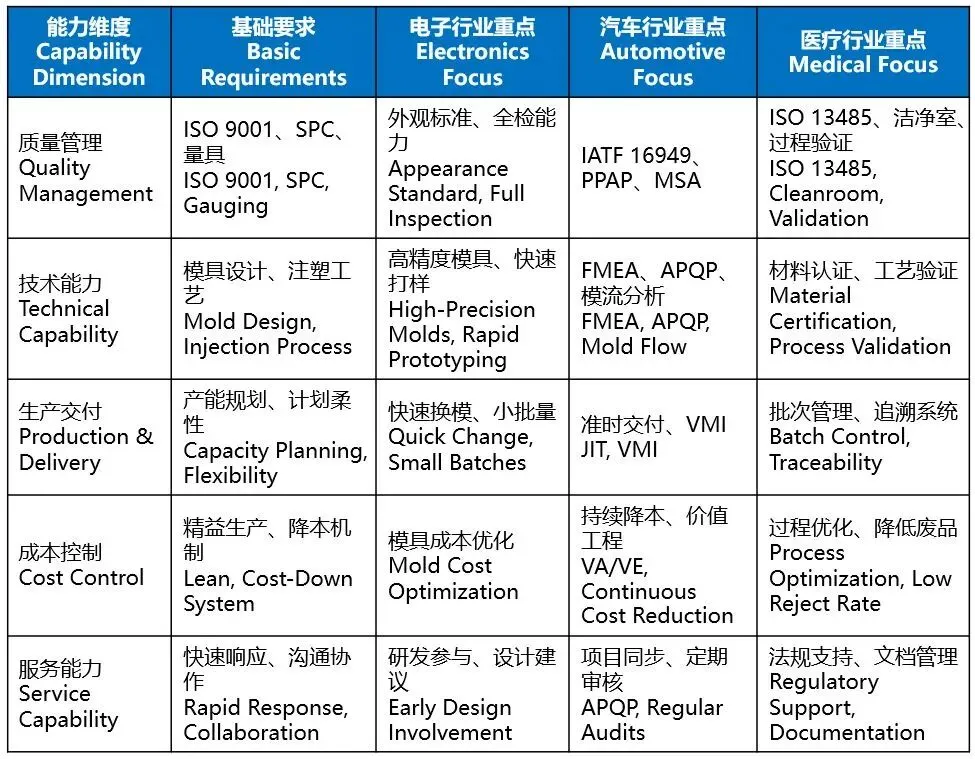
Implementation Steps:
1.Diagnose current status: Evaluate maturity and identify gaps against target customers.
2.Set priorities: Focus on key capabilities for your strategic industry.
3.Make action plans: Define measures, owners, and timelines.
4.Verify & iterate: Test improvements through real projects and adjust continuously.
实施步骤:
诊断现状:评估当前各项能力的成熟度,找出与目标客户要求的差距。
确定优先级:根据战略方向(如主攻哪个行业),优先发展该行业的关键能力。
制定行动计划:明确每个能力提升的具体措施、责任人、时间节点。
验证与迭代:通过客户项目验证能力提升效果,不断调整优化。
Management Practice:
管理实践:
Insight into Demand, Build Capability, Earn Trust
Customer demand analysis is not a one-time task but continuous insight. Managers must monitor industry trends and customer changes to translate external needs into internal capability development.
•For electronics: pursue speed and precision.
•For automotive: pursue strictness and stability.
•For medical: pursue cleanliness and completeness.
Across all industries, quality, technology, delivery, cost, and service remain the foundation. When capabilities closely match customer demands, business breakthrough follows naturally.
洞察需求,构建能力,赢得信任
客户需求分析不是一次性的工作,而是持续的洞察。模塑厂的管理者要时刻关注行业动态、客户变化,将外部需求转化为内部能力建设的动力。
对于电子行业,我们要练就“快”和“精”的本领;对于汽车行业,我们要修炼“严”和“稳”的内功;对于医疗行业,我们要追求“洁”和“全”的体系。而在所有行业中,质量、技术、交付、成本、服务这五项基本功,永远是我们的立身之本。
当我们的能力与客户的需求高度匹配时,业务突破就水到渠成。