




嘉业恒长,乐勤好德,铭守初心,宽怀笃实,铤进百年
Sustained Prosperity, Diligence & Virtue, Uphold Original Aspiration
Broad-minded & Steadfast, Forge Forward for a Century
国内不动产全面迈入存量盘活周期,大量写字楼、商业裙楼、闲置国资物业、老旧配套楼宇等待重新定位改造,酒店成为众多投资方、城投业主重点考量的盘活路径。市场里长期存在一种普遍投资误区:投资人优先洽谈租金、锁定物业租赁关系,后续才着手论证楼宇是否适合改造酒店、匹配什么档次的酒店产品。
China’s real estate sector has fully entered an era of stock asset revitalization. Numerous office towers, commercial annexes, idle state-owned assets and aged supporting buildings await repositioning and renovation, making hotels a priority revitalization option for investors and urban investment owners. A prevalent investment misunderstanding persists in the market: investors negotiate rent and secure property leasing terms first, and only afterwards verify whether the building can be converted into a hotel and which hotel tier it fits.
董乐对此点明核心逻辑:酒店项目的投资成败,在签订租赁或收购协议之前就基本定格。精细化运营能够优化营收、压缩经营损耗,弥补后天管理短板,但无法逆转建筑本体、合规条件带来的先天硬伤。一旦接手存在不可逆缺陷的物业,持续追加的改造投入极易成为沉没成本,长期困住整个资产。
Johnson Dong clarifies the core logic:The success or failure of a hotel investment is largely determined before signing a lease or acquisition agreement. Refined operation can boost revenue and cut operational losses to remedy acquired management weaknesses, yet it cannot reverse inherent flaws stemming from building structure and compliance conditions. Taking over a property with irreversible defects will trap investors in continuous renovation spending that risks turning into sunk costs, burdening the asset for years.
很多投资者判断物业,仅仅依靠地段热度、租金高低两个维度进行决策,忽略业态适配性前置尽调。郭宽宏结合多年高端酒店筹开与全域运营实战经验分析:“同一商圈内,两套区位相近的物业租金差距有限,但结局天差地别。一套建筑条件适配,可以平稳改造为中端商务酒店,客房排布规整、改造成本可控;另一套受制于层高、柱网、消防、产权限制,勉强改造之后有效客房数量大幅缩减,改造成本持续超预算,并且常年面临能耗偏高、维护成本居高不下的难题。单纯依靠租金高低选择物业,是酒店投资中最高发的致命失误。”
Many investors judge properties merely based on location popularity and rental price, ignoring due diligence on format adaptability in advance. Drawing on years of practical experience in high-end hotel pre-opening and comprehensive operation, Derek Guo analyzes: “Two properties with similar locations within the same business district may have comparable rent, yet deliver vastly different outcomes. One with suitable building conditions can be smoothly renovated into a mid-scale business hotel with well-arranged guest rooms and controllable renovation expenses. The other is constrained by floor height, column grid, fire protection and property rights. Forced renovation leads to a sharp reduction in viable rooms, continuous budget overruns, chronically high energy consumption and mounting maintenance costs. Selecting properties purely based on rent level is the most frequent fatal error in hotel investment.”
曾庆波依托大量存量资产尽调、城投物业盘活案例,从资管视角进一步补充:“资管视角下,物业综合持有成本绝不只是账面租金。投资人必须叠加结构加固投入、机电扩容改造、合规整改费用、长期运营效率损耗进行全盘测算。不少表面租金低廉的楼宇,隐藏的改造支出会完全抹平租金优势,最终直接让项目失去投资价值。”
Based on abundant cases of stock asset due diligence and urban investment property revitalization, David Zeng further supplements from an asset management perspective: “From an asset management standpoint, the comprehensive holding cost of a property extends far beyond nominal rent. Investors must conduct holistic calculations covering structural reinforcement, electromechanical capacity expansion, compliance rectification fees and long-term operational efficiency losses. Many buildings with seemingly low rent carry hidden renovation expenses that completely erase rental advantages, ultimately rendering the project unviable for investment.”
一、分清物业两类缺陷:不可逆先天硬伤 VS 可控整改问题
I. Two Categories of Property Defects: Irreversible Inherent Flaws vs. Remediable Issues
物业研判最重要的前置标准,就是清晰区分问题类型。一部分缺陷属于后期投入资金能够优化、成本可以量化管控;另一类扎根于土地规划、建筑原始设计、法定规范,属于不可逆先天硬伤。遇到存在重大不可逆硬伤的物业,应当果断放弃,不能抱有持续追加资金就能妥善解决的幻想。
The most critical preliminary standard for property evaluation is distinguishing different types of issues. Some defects can be optimized through capital injection with quantifiable and controllable costs. Others are rooted in land planning, original building design and legal regulations, defined as irreversible inherent flaws. Properties with severe irreversible defects should be rejected decisively, without the illusion that unlimited capital can deliver a solution.
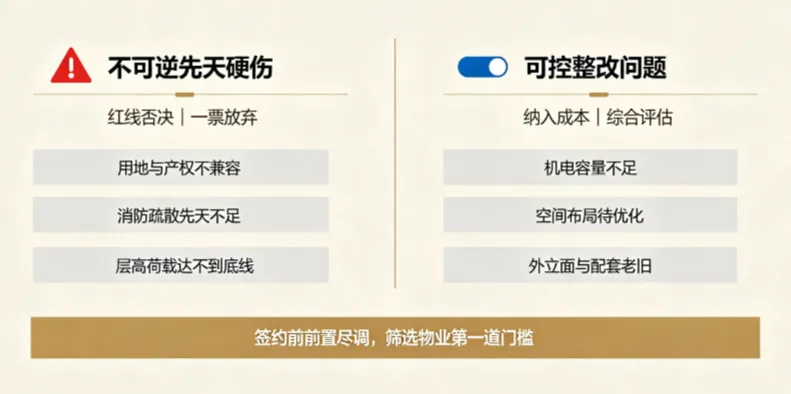
(一)不可逆先天硬伤|投资红线,一票否决
(1) Irreversible Inherent Flaws|Investment Red Lines, Automatic Rejection
1. 用地与产权性质不兼容
不动产权证规划用途为住宅、厂房、仓储,属地住建、公安、消防政策明确不允许变更业态用于旅馆经营,无法申领特种行业许可证;物业存在司法查封、多重抵押、分割零散产权。这类物业无论租金价格多低,坚决规避。
1. Incompatible land usage and property rights
Properties registered as residential, factory or warehouse use, where local housing authority, public security and fire departments explicitly forbid conversion to hotel operation and block special hotel license applications. Assets subject to judicial seizure, multiple mortgages or fragmented divided ownership must be avoided regardless of low rental offers.
2. 消防疏散基础条件不达标
原有疏散楼梯数量、疏散宽度、疏散距离无法满足酒店类特殊建设工程规范;建筑外部没有空间增设疏散楼梯;地块缺失合规消防车道、消防登高操作场地。酒店消防规范属于强制性条文,无法依靠室内装修规避,结构性改造造价极高,绝大多数场景不具备落地可行性。
2. Unqualified basic fire evacuation conditions
Insufficient quantity, width and spacing of original evacuation stairwells; no available exterior space to build additional escape stairs; lack of compliant fire access roads and rescue operation areas on the land. Fire codes for hotels are mandatory standards that cannot be bypassed through interior decoration. Structural reconstruction involves prohibitive costs and is unfeasible in most scenarios.
3. 层高、结构荷载达不到业态底线
楼板活荷载无法承载客房墙体、卫生间回填、暖通机电设备荷载;管线铺设、吊顶完工之后,客房剩余净高达不到目标酒店业态最低标准。该问题大量出现在老旧写字楼,改造完成之后空间压抑,无法满足中端及以上酒店产品基础要求。
3. Floor height and structural load fail to meet format baseline requirements
Floor slab live load cannot support partition walls, toilet backfilling, HVAC and electromechanical equipment. After pipeline installation and ceiling construction, the residual clear room height fails to meet the minimum standard of the target hotel tier. This issue is widespread in aging office buildings, resulting in cramped interior space unsuitable for mid-scale and upscale hotel positioning after renovation.
(二)可控整改问题|纳入投资测算,综合评估可行性
(2) Remediable Issues|Include in Investment Calculation for Comprehensive Feasibility Evaluation
机电供电容量不足、排水管网管径偏小、缺少独立设备机房、外立面视觉老旧、大堂面积局促、少量暗间客房。上述问题可以通过资金投入完成优化,但尽调阶段必须精准核算完整改造总投入,重新测算单房投资额、静态投资回收期,再推进租金谈判与合作磋商。
Typical examples include insufficient power supply capacity, undersized drainage pipelines, absence of dedicated mechanical equipment rooms, outdated facades, limited lobby space and a small number of windowless interior rooms. These problems can be resolved with capital investment. Nevertheless, full renovation costs must be accurately calculated during due diligence to recalculate per-room investment and static payback period prior to rent negotiation and cooperation discussion.
核心研判准则:不可逆硬伤直接放弃;存在可控整改缺陷,先核算全部改造成本,再商议租赁价格。
Core Evaluation Principle: Abandon properties with irreversible flaws. For assets with remediable defects, calculate total renovation expenditure before negotiating rental terms.
二、五步完整研判框架:精准匹配物业与酒店业态
II. Five-step Complete Evaluation Framework: Accurately Match Properties and Hotel Formats
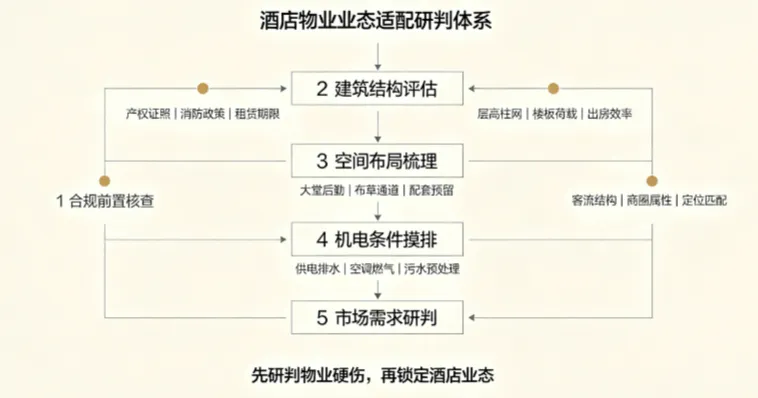
投资方实地踏勘物业,必须遵循合规核查→建筑结构→空间布局→机电配套→市场适配的顺序逐层评估,客观判定物业适合打造经济型酒店、中端商务酒店、城市度假酒店或是服务式公寓。杜绝预先锁定酒店品牌,强行倒逼物业适配既定产品。
When conducting on-site property inspections, investors must follow the evaluation sequence: compliance verification → building structure → spatial layout → electromechanical supporting facilities → market adaptability. Objectively judge whether the asset suits budget hotels, mid-scale business hotels, urban resorts or serviced apartments. Avoid committing to a hotel brand in advance and forcing the property to adapt to a predefined product.
第一步:合规前置核查,守住项目生存底线
Step 1: Pre-verification of Compliance to Secure Project Survival
1. 调取不动产权证书,核实规划用地性质;主动对接属地消防、公安治安、住建主管部门,书面确认该地址允许设立旅馆业态。
1. Obtain property title certificates and verify land usage classification; formally consult local fire, public security and housing authorities to obtain written confirmation that hotel operation is permitted at the address.
2. 查询片区控制性详细规划,排查短期拆迁、道路征收、用地调整计划,防止项目运营中途面临关停风险。
2. Review district regulatory planning documents to check for imminent demolition, road expropriation and zoning adjustment plans, eliminating the risk of forced business closure mid-operation.
3. 理清产权人、二房东完整授权链条,保证租赁期限能够覆盖投资回本周期,预留到期续约协商机制。
3. Sort out the complete authorization chain between owners and sublessors, ensuring the lease term covers the investment payback cycle and contains mechanisms for lease renewal negotiation upon expiry.
第二步:评估建筑结构,测算客房产出效率上限
Step 2: Evaluate Building Structure and Calculate Upper Limit of Room Output
建筑本体条件,直接决定一栋楼宇可打造客房总数与产品品质天花板,重点关注三项核心指标:
The building structure directly determines the maximum room quantity and ceiling of product quality. Focus on three core indicators:
1. 层高标准:装修完工后经济型客房净高≥2.5m;中端商务酒店≥2.6m;高端酒店≥2.7m。净高不达标,直接限制项目业态定位上限。
1. Floor Height Standard: Finished clear height ≥2.5m for budget hotels, ≥2.6m for mid-scale business hotels, ≥2.7m for upscale hotels. Substandard height directly caps the project’s achievable positioning tier.
2. 柱网与建筑进深:理想客房柱距区间7.2m–8.4m,建筑进深9–11米,便于排布单面自然采光客房,控制暗间比例。暗客房占比超过15%,不适宜打造中端及以上酒店。
2. Column Grid & Building Depth: Ideal column spacing ranges from 7.2m to 8.4m, with building depth between 9–11 meters, facilitating layout of naturally lit rooms and controlling the proportion of windowless units. Projects with over 15% windowless rooms are not suitable for mid-scale and above positioning.
3. 楼板荷载:客房区域楼板活荷载最低标准2.0kN/㎡;如需大面积增设卫生间,提前评估结构加固范围与整体造价。
3. Floor Load: Minimum live load standard for guest room zones is 2.0kN/㎡. If a large number of new restrooms will be constructed, assess the scope of structural reinforcement and overall construction costs in advance.
第三步:梳理空间布局,测算大堂、后勤、配套配比
Step 3: Sort Out Spatial Layout and Calculate the Ratio of Lobby, Back-of-house and Supporting Areas
很多投资人只关注客房数量,忽视大堂、后勤库房、员工区域、设备机房、布草通道等必备空间。如果楼宇缺少独立后勤流线,客房区域与后勤动线交叉干扰,后期运营管理效率持续降低,还会影响宾客体验。同时预留宴会、商业配套拓展空间,为资产长期增值埋下伏笔。
Many investors only focus on room quantity, ignoring essential spaces including lobbies, back-of-house warehouses, staff zones, equipment rooms and linen corridors. Without independent back-of-house circulation, crossing routes between guest areas and service zones will continuously reduce operational efficiency and damage guest experience. Meanwhile, reserve space for banquets and commercial supporting facilities to lay the groundwork for long-term asset appreciation.
第四步:摸排机电基础条件,核算扩容改造成本
Step 4: Survey Basic Electromechanical Conditions and Calculate Capacity Expansion Costs
重点核查供电总容量、给排水管网、中央空调基础、燃气管道、污水预处理条件。存量楼宇普遍机电标准老旧,扩容改造资金往往是一笔大额隐性支出。尽调阶段完成负荷测算,避免改造中途出现资金缺口,延误项目筹开进度。
Focus on total power supply capacity, water supply & drainage pipelines, central air conditioning infrastructure, gas pipelines and sewage pretreatment facilities. Stock buildings generally feature outdated electromechanical standards, and capacity expansion requires substantial hidden investment. Complete load calculation during due diligence to prevent capital shortages during renovation and delays to pre-opening schedules.
第五步:市场需求研判,匹配精准酒店定位
Step 5: Research Market Demand to Formulate Targeted Hotel Positioning
物业硬件达标之后,最终业态必须贴合板块客流结构:商务区优先商务酒店;景区、近郊地块适配城市度假酒店;科创园区、人才社区适合服务式公寓。杜绝脱离市场需求,盲目照搬热门酒店产品,造成客房供需错配,长期入住率承压。
After confirming the property meets hardware standards, the final format must align with local passenger flow structure: business districts suit business hotels; scenic and suburban land parcels fit urban resorts; science parks and talent communities are ideal for serviced apartments. Avoid blindly copying popular hotel products without considering market demand. Mismatched supply and demand will weigh down occupancy rates in the long run.
三、总结:前置尽调,从源头规避投资风险
III. Conclusion: Advance Due Diligence to Avoid Investment Risks From the Source
酒店投资绝非先拿楼、再改造、最后慢慢经营。正确逻辑是以资产全周期视角前置研判物业先天条件,把合规、结构、成本风险在签约之前全部排查完毕。守住不可逆硬伤的否决红线,量化所有可整改投入,结合市场需求敲定业态定位,才是稳健投资的起点。
Hotel investment is not a sequence of acquiring a property first, conducting renovation, and commencing operation afterwards. The rational approach is to assess inherent property conditions from a full-lifecycle asset perspective, and investigate all compliance, structural and cost risks prior to signing agreements. Reject assets with irreversible flaws, quantify all renovation expenditure, and confirm positioning according to market demand. This marks the starting point of sound investment.
董乐|嘉乐铭创始人表示:存量酒店投资的核心竞争力,早已不是拿房能力,而是前置研判与风险筛选能力。行业红利消退后,粗放式拿楼、赌地段、靠后期补救的投资模式已经彻底失效。真正稳健的资产投资,是尊重建筑先天属性、尊重市场客观规律,不盲从低价物业、不高估运营修复能力,用专业尽调筛除风险、用精准定位锁定收益,让每一笔改造投入都能转化为资产的长期价值增量。
Johnson Dong|Founder of GALLMÉRE states: The core competitiveness of stock hotel investment no longer lies in property acquisition capability, but in advanced judgment and risk screening capability. With the fading of industry dividends, the extensive investment model of blind property acquisition, excessive reliance on location advantages and later-stage remedial operation has completely failed. Sound asset investment respects inherent building attributes and objective market rules, avoids blind pursuit of low-rent properties and overestimation of operational remediation capabilities. Professional due diligence eliminates risks and precise positioning secures returns, enabling every renovation investment to be converted into long-term asset value growth.
葛绪斌|嘉乐铭执行董事、缤铤企业董事长补充谈到:当下大量科创载体、产业园配套楼宇、中小微企业闲置载体寻求盘活转型,不少国资、民营业主纷纷将酒店改造作为核心盘活路径。物业转型绝非简单的装修翻新,更不能仅凭主观意愿盲目立项。必须依托专业团队开展全方位前置尽调,统筹合规条件、建筑硬伤、改造成本、市场适配、资产流动性五大核心维度,平衡短期盘活效率与长期资产增值。唯有以专业研判为基础、以资产价值为核心、以稳健经营为目标,才能让存量物业实现可持续盘活,真正做到资产保值、稳健增收、长效发展。
Gene Ge|Executive Director of GALLMÉRE, Chairman of JNBTG ACCURE,
adds: At present, a large number of science and innovation carriers, industrial park supporting buildings and idle premises of small and medium-sized enterprises are seeking revitalization and transformation, and many state-owned and private owners regard hotel renovation as a core revitalization path. Property transformation is never a simple decoration upgrade, nor can projects be launched blindly based on subjective will. Professional teams must conduct comprehensive preliminary due diligence, coordinating five core dimensions including compliance conditions, building inherent flaws, renovation costs, market adaptability and asset liquidity, so as to balance short-term revitalization efficiency and long-term asset appreciation. Only based on professional judgment, centered on asset value and targeted at stable operation, can stock properties achieve sustainable revitalization, realizing asset preservation, steady income growth and long-term development.
联系我们 Contact Us
联系我们 Contact Us
商务合作对接:曾庆波首席发展官
Business Contact: David Zeng, Chief Development Officer
手机 : 15385859078
Mobile : 15385859078
储备待开业项目 Upcoming Opening Projects
南通华通温德姆酒店|2027 年 11 月开业
Nantong Huatong Wyndham | Opening Nov 2027
