



要点
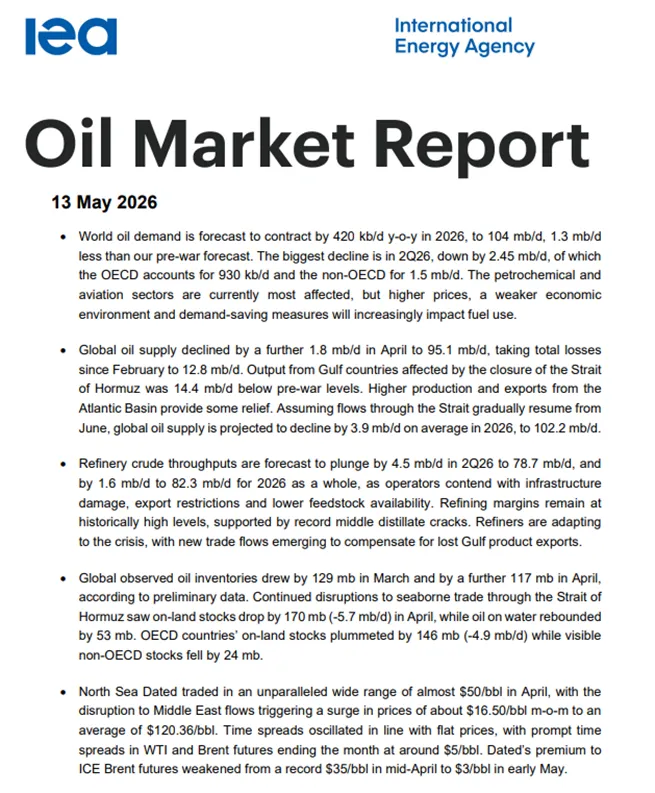
预计2026年全球石油需求同比将萎缩420千桶,至每日1.04亿桶,比战前预测少130万桶。最大跌幅出现在2026年第二季度,下降245万桶/日,其中经合组织为930千桶/日,非经合组织为150万桶/日。目前受影响最严重的是石化和航空行业,但价格上涨、经济环境疲软以及需求节约措施将日益影响燃料使用。
全球石油供应在四月又减少180万吨/日,至9510万桶/天,自2月以来的总损失达到1280万桶/日。受霍尔木兹海峡关闭影响的海湾国家产量比战前低1440万桶/日。大西洋盆地的产量和出口增加带来了一定缓解。假设从6月起海峡的石油流量逐步恢复,预计2026年全球石油供应平均减少390万桶/日,降至1.022亿桶/日。
预计炼油厂原油加工量将在2026年第二季度下降450万桶,降至787万桶/天,2026年全年将下降160万桶至8230万桶/天,运营商正面临基础设施破坏、出口限制和原料供应减少等问题。炼油利润率保持在历史高位,中间馏分液裂解价差创纪录。炼油厂正在适应危机,新的贸易流涌现以弥补海湾产品出口的损失。
根据初步数据,全球观察到的石油库存在3月份下降了1.29亿桶,4月份又下降了1.170亿桶。霍尔木兹海峡海上贸易持续受阻,导致4月份陆上库存减少1.7亿桶(-570万桶/日),而海上油库存量反弹了5300万桶。经合组织国家陆地库存骤降1.46亿桶(下降490万桶/天),可见非经合组织库存减少2400万桶。
北海布伦特日前原油价格在4月份出现近50美元/桶的无与伦比的宽泛交易区间,中东市场流量受阻导致价格月比上涨约16.50美元/桶,平均涨至120.36美元/桶。时间价差与价格持平一致,WTI和布兰特期货的及时价差最终以约5美元/桶结束。布伦特日前价格与ICE布伦特期货的溢价从4月中旬创纪录的35美元/桶下跌至5月初3美元/桶。
填补缺口
中东战争爆发十多周后,霍尔木兹海峡不断增加的供应损失正以创纪录的速度消耗全球石油库存。基准油价因美国和伊朗是否会很快达成协议结束冲突的相互矛盾信号而剧烈波动,北海日前价格从每桶144美元高点暴跌至低于100美元,随后又反弹。撰写本文时,两国仍在围绕重新开放海峡、结束战争的协议对峙,北海日前价格约为每桶110美元。
由于霍尔木兹油轮运输仍受限制,海湾生产商累计供应损失已超过10亿桶,超过1400万桶/日原油被关停,造成前所未有的供应冲击。不过,当前的供需差距显著缩小,因为市场在危机前已处于盈余状态,生产者和消费者都在响应市场信号。
在供应方面,沙特阿拉伯和阿联酋成功将部分出口重新导向到海峡外装载的码头。与此同时,消费国商业和政府战略储存场地的库存也流入市场,以弥补部分损失。全球观察到的库存,包括水上油,在3月和4月间减少了2.5亿桶,即400万桶/日。中东以外的生产者也推动了产量提升,并将出口提升至历史新高,以应对危机。事实上,自年初以来,美洲地区的2026年供应增长预期已上调超过600千桶/日,平均为150万桶/天。此外,大西洋盆地原油出口自2月以来增长了350万桶/天,其中美国、巴西、加拿大、哈萨克斯坦和委内瑞拉均有显著增长。俄罗斯原油出口也有所增加,因为多次对炼油厂的攻击减少了国内用量,导致出货量增加,而美国则暂时解除了对俄罗斯水上石油的制裁。
在需求方面,炼油厂减少了加工量,并大幅减少了原油进口。据Kpler报道,中国海运原油进口量从2月到4月大幅下降了360万桶/天。日本(-190万桶/天)、韩国(-100桶/天)和印度(-760千桶/天)也出现了进口大幅减少。但尽管全球炼油活动放缓——今年4月同比下降约500万桶——暂时缓解了原油市场的紧张局势,但紧张情绪正迅速蔓延到产品市场。
终端用户也在减少用电量。预计全球石油需求在2026年第二季度同比将萎缩240万桶/日,全年下降420千桶/日,比我们冲突前的预测弱130万桶/日。目前,石化行业损失最为严重,原料供应日益紧张。航空活动也远低于正常水平,缓解了喷气燃料价格的压力,后者在中东出口被切断后价格几乎翻了三倍。价格上涨、经济环境恶化以及需求节约措施将进一步加重全球石油消费。
如果达成结束战争的协议,允许霍尔木兹海峡的流动从2026年第三季度逐步恢复,预计年底需求可能会回升增长,但供应恢复速度可能会较慢。因此,石油市场一直处于逆差状态,直到年底最后一个季度。随着全球石油库存已创纪录地减少,夏季需求高峰前价格波动可能进一步加剧。
Highlights
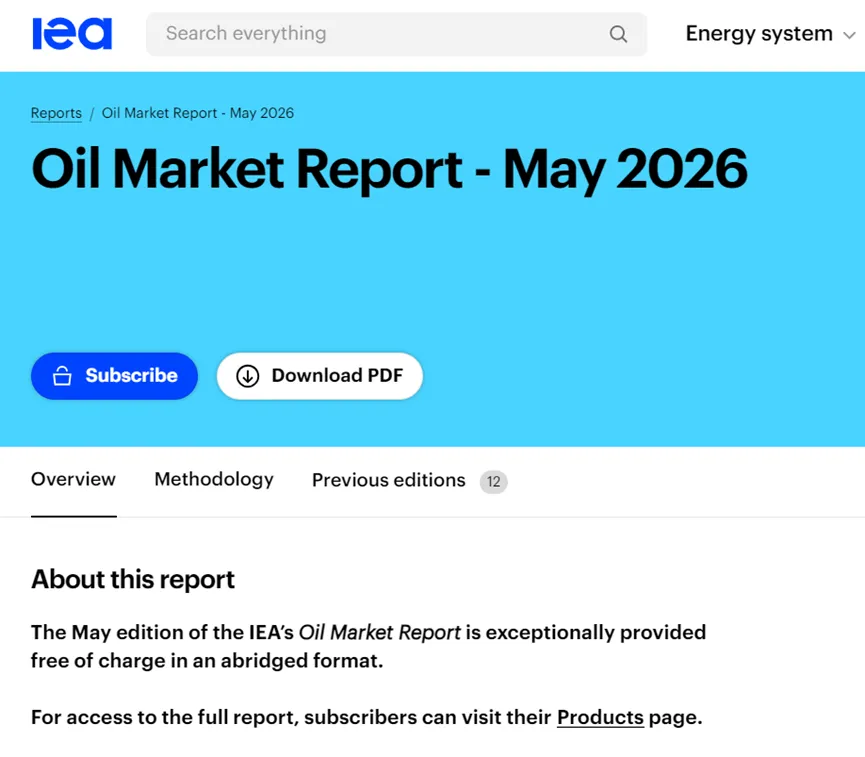
World oil demand is forecast to contract by 420 kb/d y-o-y in 2026, to 104 mb/d, 1.3 mb/d less than our pre-war forecast. The biggest decline is in 2Q26, down by 2.45 mb/d, of which the OECD accounts for 930 kb/d and the non-OECD for 1.5 mb/d. The petrochemical and aviation sectors are currently most affected, but higher prices, a weaker economic environment and demand-saving measures will increasingly impact fuel use.
Global oil supply declined by a further 1.8 mb/d in April to 95.1 mb/d, taking total losses since February to 12.8 mb/d. Output from Gulf countries affected by the closure of the Strait of Hormuz was 14.4 mb/d below pre-war levels. Higher production and exports from the Atlantic Basin provide some relief. Assuming flows through the Strait gradually resume from June, global oil supply is projected to decline by 3.9 mb/d on average in 2026, to 102.2 mb/d.
Refinery crude throughputs are forecast to plunge by 4.5 mb/d in 2Q26 to 78.7 mb/d, and by 1.6 mb/d to 82.3 mb/d for 2026 as a whole, as operators contend with infrastructure damage, export restrictions and lower feedstock availability. Refining margins remain at historically high levels, supported by record middle distillate cracks. Refiners are adapting to the crisis, with new trade flows emerging to compensate for lost Gulf product exports.
Global observed oil inventories drew by 129 mb in March and by a further 117 mb in April, according to preliminary data. Continued disruptions to seaborne trade through the Strait of Hormuz saw on-land stocks drop by 170 mb (-5.7 mb/d) in April, while oil on water rebounded by 53 mb. OECD countries’ on-land stocks plummeted by 146 mb (-4.9 mb/d) while visible non-OECD stocks fell by 24 mb.
North Sea Dated traded in an unparalleled wide range of almost $50/bbl in April, with the disruption to Middle East flows triggering a surge in prices of about $16.50/bbl m-o-m to an average of $120.36/bbl. Time spreads oscillated in line with flat prices, with prompt time spreads in WTI and Brent futures ending the month at around $5/bbl. Dated’s premium to ICE Brent futures weakened from a record $35/bbl in mid-April to $3/bbl in early May.
Plugging the gap
More than ten weeks after the war in the Middle East began, mounting supply losses from the Strait of Hormuz are depleting global oil inventories at a record pace. Benchmark oil prices have posted wild swings in response to conflicting signals on whether the United States and Iran will soon reach a deal to end the conflict, with North Sea Dated plunging from a high of $144/bbl to below $100/bbl before rebounding again. At the time of writing, the two countries remained at loggerheads over an accord to reopen the Strait and end the war, with North Sea Dated around $110/bbl.
With Hormuz tanker traffic still restricted, cumulative supply losses from Gulf producers already exceed 1 billion barrels with more than 14 mb/d of oil now shut in, an unprecedented supply shock. The current supply-demand gap is significantly smaller, however, as the market was already in surplus heading into the crisis while producers and consumers alike are responding to market signals.
On the supply side, Saudi Arabia and the UAE have successfully redirected some exports to terminals loading outside of the Strait. At the same time, stocks from commercial and government strategic storage sites in consuming countries are flowing into markets to offset part of the losses. Observed global inventories, including oil on water, were drawn down by 250 mb over March and April, or 4 mb/d. Producers outside of the Middle East also pushed output higher and lifted exports to record levels in response to the crisis. Indeed, 2026 supply growth expectations from the Americas have been revised up by more than 600 kb/d since the start of the year, to 1.5 mb/d on average. Moreover, Atlantic Basin crude oil exports, now heading primarily to hard-hit East of Suez markets, have increased by 3.5 mb/d since February, with notable gains from the United States, Brazil, Canada, Kazakhstan and Venezuela. Russia’s crude oil exports have also risen, as repeated attacks on its refineries have cut domestic use and led to higher shipments, while the United States temporarily waived sanctions on Russian oil on water.
On the demand side, refiners have reduced runs and sharply scaled back crude imports. Chinese seaborne crude imports fell by a massive 3.6 mb/d from February to April, according to Kpler. Major reductions in imports were also seen in Japan (-1.9 mb/d), Korea (-1 mb/d) and India (-760 kb/d). But while the slowdown in global refinery activity – by around 5 mb/d y-o-y in April – has temporarily eased tensions in the crude market, tightness is quickly spreading to product markets.
End users are also reducing consumption. Global oil demand is now expected to contract by 2.4 mb/d y-o-y in 2Q26 and to decline by 420 kb/d for the year as a whole, 1.3 mb/d weaker than our pre-conflict forecast. For now, the steepest losses are seen in the petrochemical sector where feedstock availability is becoming increasingly constrained. Aviation activity is also running well below normal levels, helping to ease some of the pressure on jet fuel prices, which nearly tripled after Middle Eastern exports were cut off. Higher prices, a deteriorating economic environment and demand-saving measures will further weigh on global oil consumption.
While demand may swing back to growth towards the end of the year if a deal to end the war is agreed that allows flows through the Strait of Hormuz to gradually resume from 3Q26, as is assumed in this Report, supply will likely be slower to recover. As a result, the oil market remains in deficit until the final quarter of the year. With global oil inventories already drawing at a record clip, further price volatility appears likely ahead of the peak summer demand period.
