



中国石化行业生物基解决方案
利益相关方分析报告
Stakeholder Analysis Report: Bio-based Solutions in China Petrochemical Industry
一、摘要1. Summary
本文对中国石化行业生物基解决方案相关的利益相关方进行全面系统分析,旨在为开展行业调研提供基础框架。 This report provides a comprehensive and systematic analysis of stakeholders related to bio-based solutions in China's petrochemical industry, serving as a foundational framework for Shanghai Qingyue's industry research.
生物基解决方案涵盖以生物质为原料,通过生物合成、发酵、酶催化等绿色工艺生产化学品和材料的技术路线,是石化行业实现"双碳"目标的重要路径。 Bio-based solutions refer to technological pathways that use biomass as raw material to produce chemicals and materials through green processes such as biosynthesis, fermentation, and enzymatic catalysis—key to achieving China's "dual carbon" goals.
二、利益相关方概览与分类2. Stakeholder Overview & Classification
基于Mitchell等的利益相关方理论框架,结合中国石化行业特点与生物基议题的特殊性,识别出六类核心利益相关方群体: Based on Mitchell's stakeholder theory and the characteristics of China's petrochemical industry, six core stakeholder groups are identified:
类别 Category Category | 利益相关方 Stakeholder Stakeholder | 核心诉求 Key Interests Key Interests | 影响力 Influence Influence |
政府及监管机构 Govt & Regulators Government & Regulators | 工信部/发改委/生态环境部 MIIT/NDRC/MEE Policy-making, Carbon Targets | 制定政策、碳目标、标准 Policy, Standards, Incentives Standards, Incentives | 极高 Very High Very High |
石化企业 Petrochem. Cos Petrochemical Enterprises | 中国石化、中石油、万华等 Sinopec/PetroChina/Wanhua State-owned & Private Majors | 技术转型、产品研发 Tech Transition, R&D Bio-based Products, Scale-up | 极高 Very High Very High |
品牌商及采购方 Brand Buyers Brand Owners & Buyers | 消费品牌、零售商 快速消费品, 跨国公司 Consumer Brands, Retailers,FMCG(Fast Moving Consumer Goods),MNCs | 绿色采购、ESG目标 Green Procurement, ESG Sustainable Supply Chain | 高 High High |
科研技术机构 Research & Tech Research & Tech Providers | 天津大学、华东理工、华大基因等 Tianjin Univ./ECUST/BGI Univ., Research Inst., Biotech | 合成生物学研发 SynBio R&D SynBio, Tech Transfer | 中高 Med-High Med-High |
金融机构 Financial Inst. Financial Institutions | 绿色基金/ESG评级/银行 Green Funds/ESG/Banks Green Funds, ESG, Policy Banks | 绿色债券、碳信用 Green Bonds, Carbon Green Finance, Carbon Credit | 中高 Med-High Med-High |
环保NGO及公众 NGOs & Public NGOs & Civil Society | 上海青悦等NGO ENGO such as epmap, etc. | 数据监督、信息披露 Data Oversight, Disclosure Disclosure Advocacy, Media | 中高 Med-High Med-High |
三、核心利益相关方深度分析3. In-Depth Analysis of Core Stakeholders
3.1 政府及监管机构 Government & Regulators
政府是生物基解决方案最关键的政策驱动者,通过规划引导、标准制定、财政补贴等多种工具影响行业发展方向。 The government is the most critical policy driver for bio-based solutions, influencing industry direction through planning guidance, standard-setting, and fiscal subsidies.
•工业和信息化部(MIIT):制定生物基材料产业发展专项规划,将生物制造纳入"十四五"战略性新兴产业Ministry of Industry and Information Technology: Formulates bio-based materials industry development plans; includes bio-manufacturing in strategic emerging industries
•国家发展改革委(NDRC):审批重大生物基项目,推动"碳达峰碳中和"目标实现National Development and Reform Commission: Approves major bio-based projects; drives "carbon peak and neutrality" goals
•生态环境部(MEE):制定产品碳足迹标准,推进石化行业绿色转型Ministry of Ecology and Environment: Establishes product carbon footprint standards; promotes green transformation
•中国人民银行/金融监管总局:推动绿色金融支持生物基产业PBOC/FRC: Promotes green finance to support bio-based industry
关键政策文件:2025年9月,七部门联合发布《石化化工行业稳增长工作方案(2025-2026年)》,明确提出"发展非粮生物基材料、生物化工",生物基产业迎来政策窗口期。 Key policy: In September 2025, seven ministries jointly issued the "Petrochemical Industry Stable Growth Plan (2025-2026)", explicitly proposing "developing non-grain bio-based materials and biochemicals".
3.2 石化企业 Petrochemical Enterprises
石化企业是生物基解决方案的核心实施主体,其转型意愿与能力直接决定行业发展速度。 Petrochemical enterprises are the core implementers of bio-based solutions; their willingness and capability to transform directly determines industry development speed.
•中国石化(Sinopec):2024年9月,中石化化销华中首次打通中原石化生物基聚烯烃产品销售流程,实现国内首款生物基聚烯烃产品商业化突破Sinopec: In September 2024, Sinopec Central China successfully commercialized China's first bio-based polyolefin products from Zhongyuan Petrochemical
•中国石油(PetroChina):石油化工研究院积极布局生物基化学品与材料研发,推动低碳转型PetroChina: PetroChina's research institute actively develops bio-based chemicals and materials for low-carbon transition
•万华化学(Wanhua Chemical):2024年6月发布全球首款100%生物基TPU,使用玉米秸秆制得的生物基原料Wanhua: In June 2024, released the world's first 100% bio-based TPU using corn stalk-derived raw materials
•恒逸石化、荣盛石化:积极探索生物基聚酯、可降解塑料等新兴领域Hengyi Petrochemical, Rongsheng Petrochemical: Actively exploring bio-based polyesters and biodegradable plastics
趋势研判:大型国企凭借资金与渠道优势,重点布局生物基聚烯烃、生物航煤等大体量产品;民营石化企业则在精细生物基化学品领域寻求差异化突破。 Trend: Large state-owned enterprises leverage capital and channel advantages to focus on bulk products like bio-based polyolefins and bio-jet fuel; private companies seek differentiation in fine bio-based chemicals.
3.3 品牌商及采购方 Brand Owners & Buyers
品牌商作为供应链终端需求方,通过绿色采购标准和ESG承诺,倒逼上游石化企业加速生物基转型。 Brand owners, as downstream demand drivers, are compelling upstream petrochemical companies to accelerate bio-based transition through green procurement standards and ESG commitments.
•跨国消费品企业(宝洁P&G、联合利华、欧莱雅等):设定100%可持续采购目标,要求供应商提供碳足迹报告Multinational FMCG (P&G, Unilever, L'Oreal): Set 100% sustainable procurement targets; require carbon footprint reports from suppliers
•运动品牌(耐克Nike、阿迪达斯、安踏等):使用生物基材料的"碳中和"产品成为营销卖点Sports brands (Nike, Adidas, Anta): "Carbon-neutral" products using bio-based materials are becoming marketing highlights
•零售巨头(宜家、Zara母公司Inditex等):承诺2030年前实现产品100%可再生或回收材料Retail giants (IKEA, Inditex/Zara): Committed to 100% renewable/recycled materials by 2030
对石化行业的影响:下游品牌对生物基原料的采购意愿,将直接转化为对国内石化企业的市场需求,推动规模化生产。 Impact on petrochemical industry: Brand willingness to purchase bio-based materials will directly create market demand for domestic petrochemical companies, driving scaled production.
3.4 科研与技术机构 Research & Technology Providers
科研机构是生物基解决方案的技术源泉,提供从基础研究到工程化应用的完整创新链条。 Research institutions are the technology source for bio-based solutions, providing a complete innovation chain from basic research to engineering application.
•天津大学:2006年即开展合成生物学研究,拥有"合成生物技术全国重点实验室",是中国合成生物学"开山鼻祖"Tianjin University: Pioneer in synthetic biology since 2006; home to the National Key Laboratory for Synthetic Bio-Technology
•华东理工大学:生物工程学院在生物工程、合成生物学领域积累深厚,与企业合作紧密ECUST: School of Biotechnology has deep expertise in bioengineering and synthetic biology; collaborates closely with industry
•华大基因(BGI Group):构建自主可控的高通量DNA合成平台,推动基因合成从"手工作坊"到"无人工厂"的跨越BGI Group: Building high-throughput DNA synthesis platform, upgrading gene synthesis from workshop to automated factory
•中国科学院各研究所:微生物所、过程工程所等在生物基化学品领域持续产出核心技术CAS Institutes: Institute of Microbiology and Institute of Process Engineering continuously produce core technologies for bio-based chemicals
技术转移挑战:科研成果向产业化转化仍面临中试放大、成本控制等瓶颈,需要产学研深度协作。 Tech transfer challenges: Commercializing research breakthroughs still faces scale-up and cost control bottlenecks, requiring deep industry-academia-research collaboration.
3.5 金融机构 Financial Institutions
金融机构通过绿色金融工具和ESG评价体系,为石化行业生物基转型提供资本支持与市场化激励。 Financial institutions provide capital support and market incentives for the petrochemical industry's bio-based transition through green finance tools and ESG evaluation systems.
•绿色债券与绿色贷款:生物基项目符合绿色债券支持项目目录,可享受优惠融资成本Green bonds & loans: Bio-based projects qualify for green bond support catalogs, enjoying preferential financing costs
•ESG评级机构(中证ESG、Wind ESG、商道融绿等):将生物基转型纳入石化企业ESG评分体系,影响股价和融资ESG rating agencies (CSI ESG, Wind ESG, Syntao Green): Include bio-based transition in petrochemical ESG scoring, affecting stock prices and financing
•政策性银行(国家开发银行、中国进出口银行):对重大生物基产业化项目提供政策性贷款支持Policy banks (CDB, Exim Bank): Provide policy loans for major bio-based industrialization projects
•碳交易市场:生物基产品碳减排量的碳信用变现,为企业提供额外收益来源Carbon trading market: Carbon credit monetization from bio-based product emission reductions provides additional revenue
2025年是A股ESG信息披露政策密集出台后的首年,450余家上市公司将于2026年强制披露ESG信息,生物基转型将成为重要评分维度。 2025 is the first year of intensive ESG disclosure policies for A-shares; 450+ listed companies will mandatorily disclose ESG info in 2026, making bio-based transition a key scoring dimension.
3.6 环保NGO及公众 NGOs & Civil Society
NGO通过数据监督、信息披露倡导和公众教育,推动石化行业提升生物基转型的透明度与紧迫感。 NGOs drive petrochemical companies to improve transparency and urgency in bio-based transition through data oversight, disclosure advocacy, and public education.
关键作用:NGO的数据平台和研究报告为投资者、品牌商和监管机构提供独立第三方评估依据,是推动行业变革的重要外部力量。 Key role: NGO data platforms and research reports provide independent third-party evaluation basis for investors, brands, and regulators—an important external force driving industry change.
四、影响力—利益矩阵分析5. Influence-Interest Matrix Analysis
基于Mitchell利益相关方分类法,以"影响力水平"(对生物基转型的推动/阻碍能力)和"利益相关度"(对生物基议题的关注程度)两个维度,将各利益相关方映射到四象限矩阵中: Based on Mitchell's stakeholder classification, mapping stakeholders onto a four-quadrant matrix with dimensions of "Level of Influence" (ability to promote or hinder bio-based transition) and "Level of Interest" (degree of attention to bio-based issues):
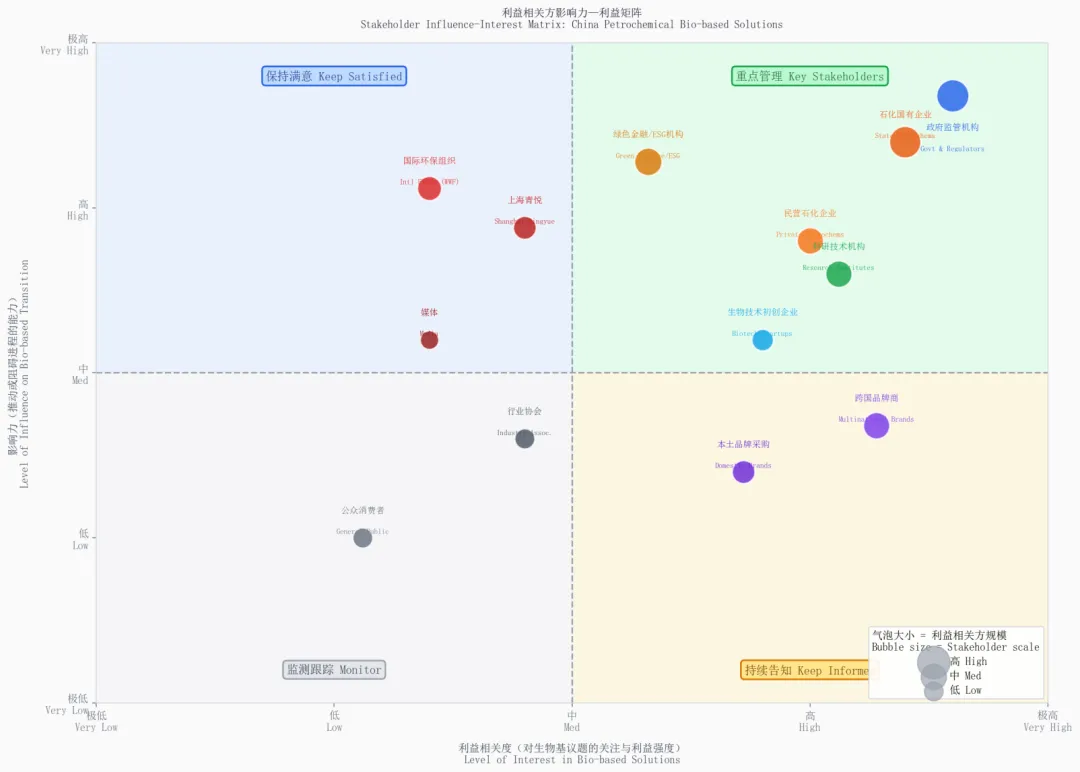
4.1 四象限管理策略 Four-Quadrant Management Strategies
•重点管理(Key Players,高影响力×高利益):政府监管机构、石化国有企业、绿色金融机构——需优先建立深度对话与合作关系Key Players (High Influence × High Interest): Govt regulators, state petrochems, green finance—prioritize deep dialogue and partnerships
•保持满意(Keep Satisfied,高影响力×低利益):国际环保组织等——需定期沟通,维护良好关系,避免其转向反对Keep Satisfied (High Influence × Low Interest): Intl ENGOs, Shanghai Qingyue—maintain regular communication and good relations to prevent turning against
•持续告知(Keep Informed,低影响力×高利益):跨国品牌商、生物技术初创企业——需主动推送行业进展,激发持续参与Keep Informed (Low Influence × High Interest): MNC brands, biotech startups—proactively share industry progress to maintain engagement
•监测跟踪(Monitor,低影响力×低利益):普通公众、行业协会——持续监测舆情,适时引导Monitor (Low Influence × Low Interest): General public, industry associations—continuously monitor public sentiment and guide when appropriate
五、结论 5. Conclusion
中国石化行业生物基解决方案正处于政策驱动与市场需求双轮加速的关键期。政府通过"十五"规划和稳增长方案提供了明确的政策信号,石化龙头企业已率先开展商业化探索,金融机构ESG评价体系为转型提供了市场激励。 Bio-based solutions in China's petrochemical industry are at a critical stage of acceleration driven by both policy and market demand. The government has provided clear policy signals through the "15th Five-Year Plan" and stable growth plans; leading petrochemical companies have pioneered commercial exploration; and ESG evaluation systems provide market incentives for transition.
作为环保NGO,可充分发挥数据监督与信息披露倡导的独特优势,推动行业透明度提升,同时通过与政府、企业、研究机构的协作,构建生物基转型的多方共赢生态。 As an environmental NGO can fully leverage its unique advantages in data oversight and disclosure advocacy to promote industry transparency, while collaborating with government, enterprises, and research institutions to build a multi-stakeholder win-win ecosystem for bio-based transition.
预计到2025年,中国生物基产品市场规模将突破220亿美元,年复合增长率约20%,中国有望成为全球生物基材料领域的领先者。 China's bio-based products market is expected to exceed USD 22 billion in 2025, with a CAGR of ~20%, positioning China as a global leader in bio-based materials.
参考资料 ReferencesReferences
1. 工业和信息化部等七部门,《石化化工行业稳增长工作方案(2025-2026年)》,2025年9月 1. MIIT et al., "Petrochemical Industry Stable Growth Plan (2025-2026)", September 2025
2. 中国石油化工股份有限公司,《2024年可持续发展报告》,2025年3月 2. Sinopec Corp., "2024 Sustainability Report", March 2025
3. 波士顿咨询(BCG),《中国合成生物学产业白皮书2024》,2024年4月 3. Boston Consulting Group, "China Synthetic Biology Industry White Paper 2024", April 2024
4. 中国石油和化学工业联合会,《石化化工企业ESG研究报告》,2023年11月 4. CPCIF, "Petrochemical Enterprise ESG Research Report", November 2023
5. 中国石油新闻中心,《生物制造:助力化学工业低碳转型》,2023年5月 5. CNPC News, "Bio-manufacturing: Supporting Low-carbon Transition of Chemical Industry", May 2023
6. 前瞻产业研究院,《2024年中国石油化工行业政策汇总》,2024年11月 6. Qianzhan Industry Research Institute, "2024 China Petrochemical Industry Policy Summary", November 2024
7. 慧聪化工网,《中国石化生物基新材料布局》,2024年10月 7. HC Chem, "Sinopec Bio-based New Materials Strategy", October 2024
免责声明:本公众号部分内容来源于合作媒体、企业机构、网友提供和互联网的公开资料等,仅供参考。本公众号对站内所有资讯的内容、观点保持中立,不对内容的准确性、可靠性或完整性提供任何明示或暗示的保证。如果有侵权等问题,请及时联系我们,我们将在收到通知后第一时间妥善处理该部分内容。
往期精彩回顾:
1.苹果称“已空前接近2030净零目标”,是真的吗?丨2026年度《环境进展报告》深度解析
3.ESG披露该由PR还是董办牵头:从监管逻辑到组织协同的最优解
?关注长三角ESG与零碳研究院公众号?
?不错过每一篇?
