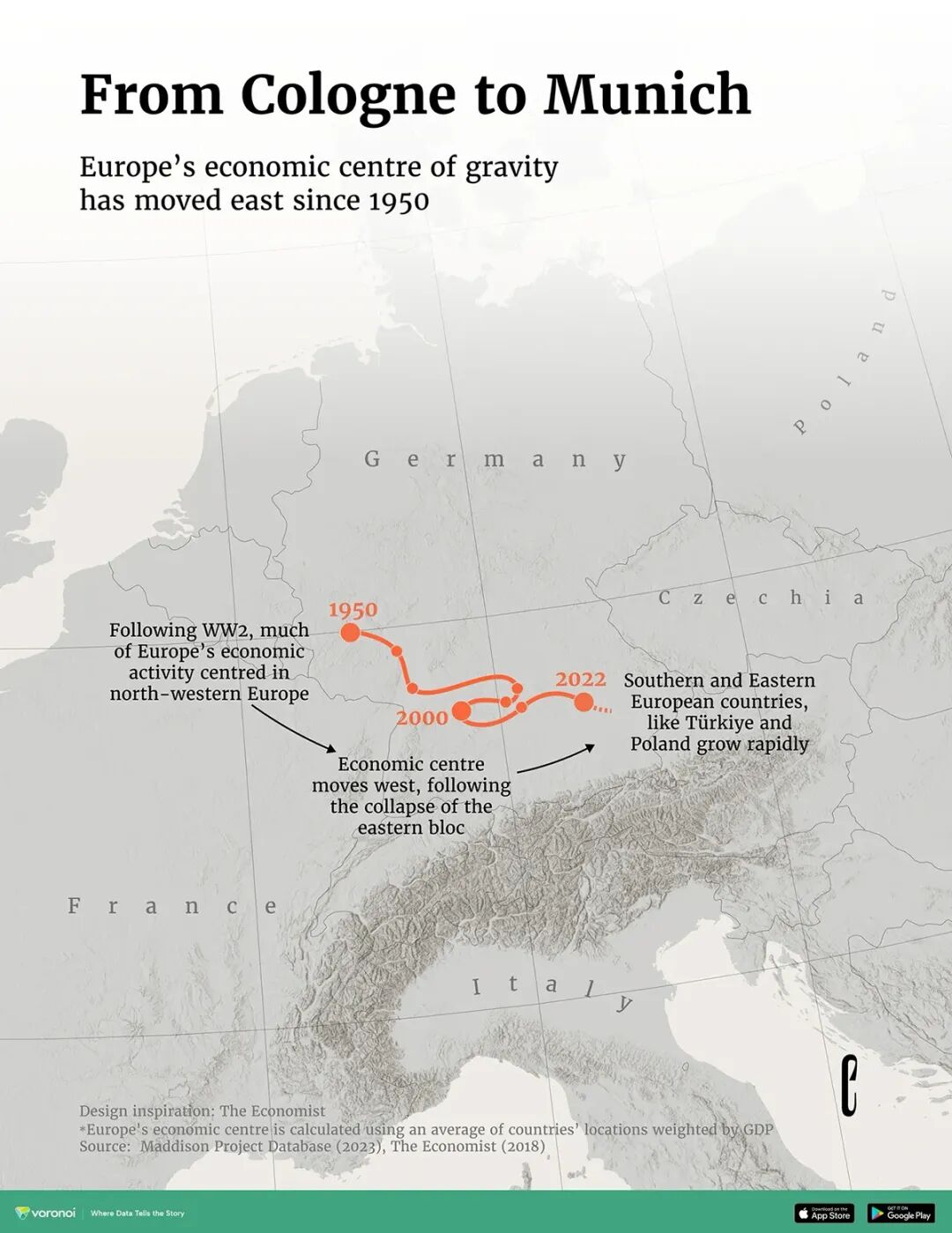
上图显示,欧洲经济重心东移(波兰,斯洛伐克,匈牙利,乃至土耳其),南移(数据来源Maddison Project Database和经济学人),数据权威性和可靠性较高,可以助力把握欧美汽车零部件企业财报,助力理解中资企业在欧洲的投资布局。The visualization, created by The European Correspondent using data from the Maddison Project Database, reveals how decades of growth in Central and Eastern Europe have gradually reshaped the continent’s economic geography.
The Rise of the East
Since the end of the Cold War, the center has gradually shifted eastward.
The collapse of the Soviet bloc opened Central and Eastern European economies to global trade and investment. Countries like Poland, Czechia, and Hungary integrated into EU supply chains and saw rapid economic expansion.
More recently, fast-growing economies in Southeastern Europe and Türkiye have added additional pull. Together, these changes nudged Europe’s economic center toward Bavaria, landing near Munich by 2022.
Germany Still Anchors Europe’s Economy
In other words, while Eastern Europe is rising, Germany’s gravitational pull still holds the balance point nearby, at least for now.source:https://www.visualcapitalist.com/cp/europes-economic-center-of-gravity/
Published1 week ago on
ByThe European Correspondent
Featured Creator
Article/Editing:Visual Capitalist
如有侵权立删。If there is any infringement, it will be deleted immediately.