


报告内容简介:
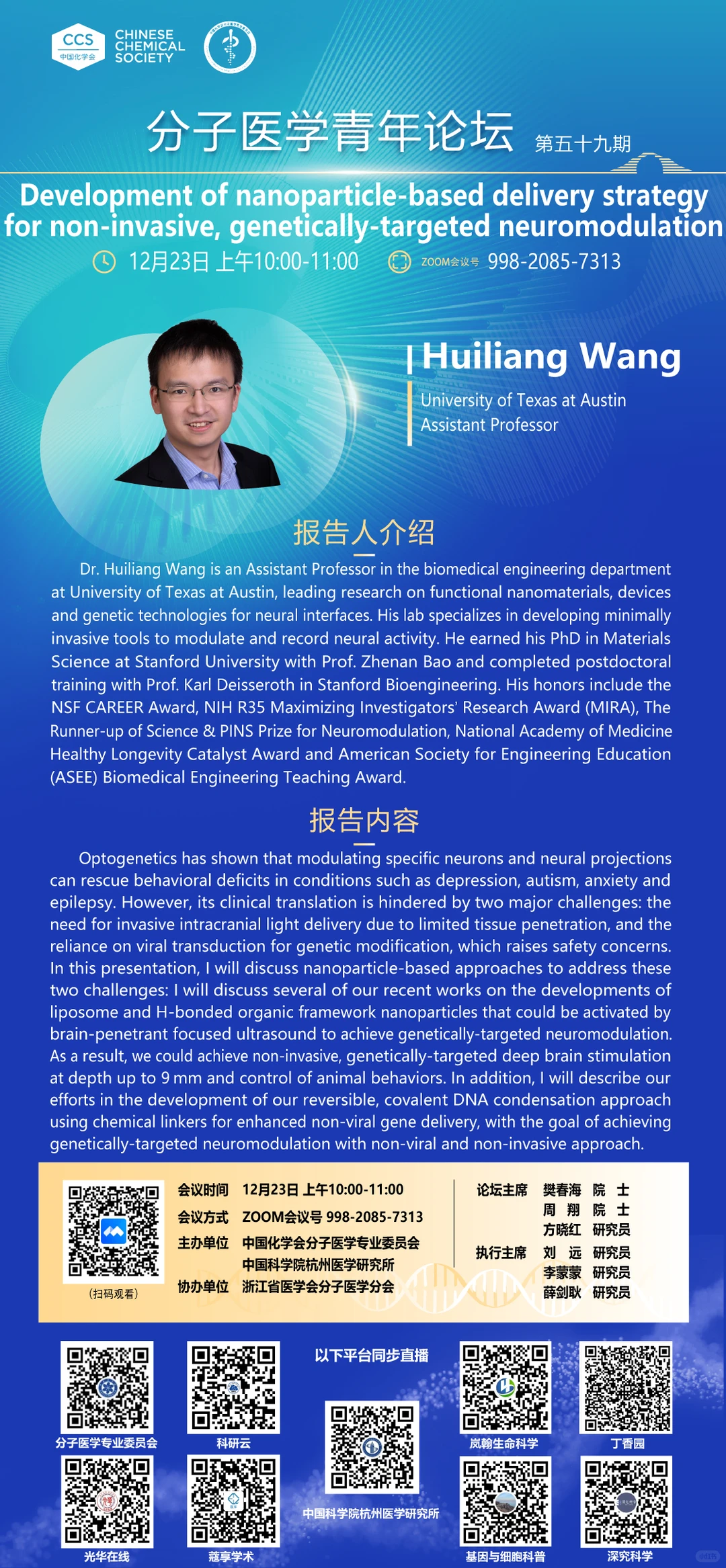
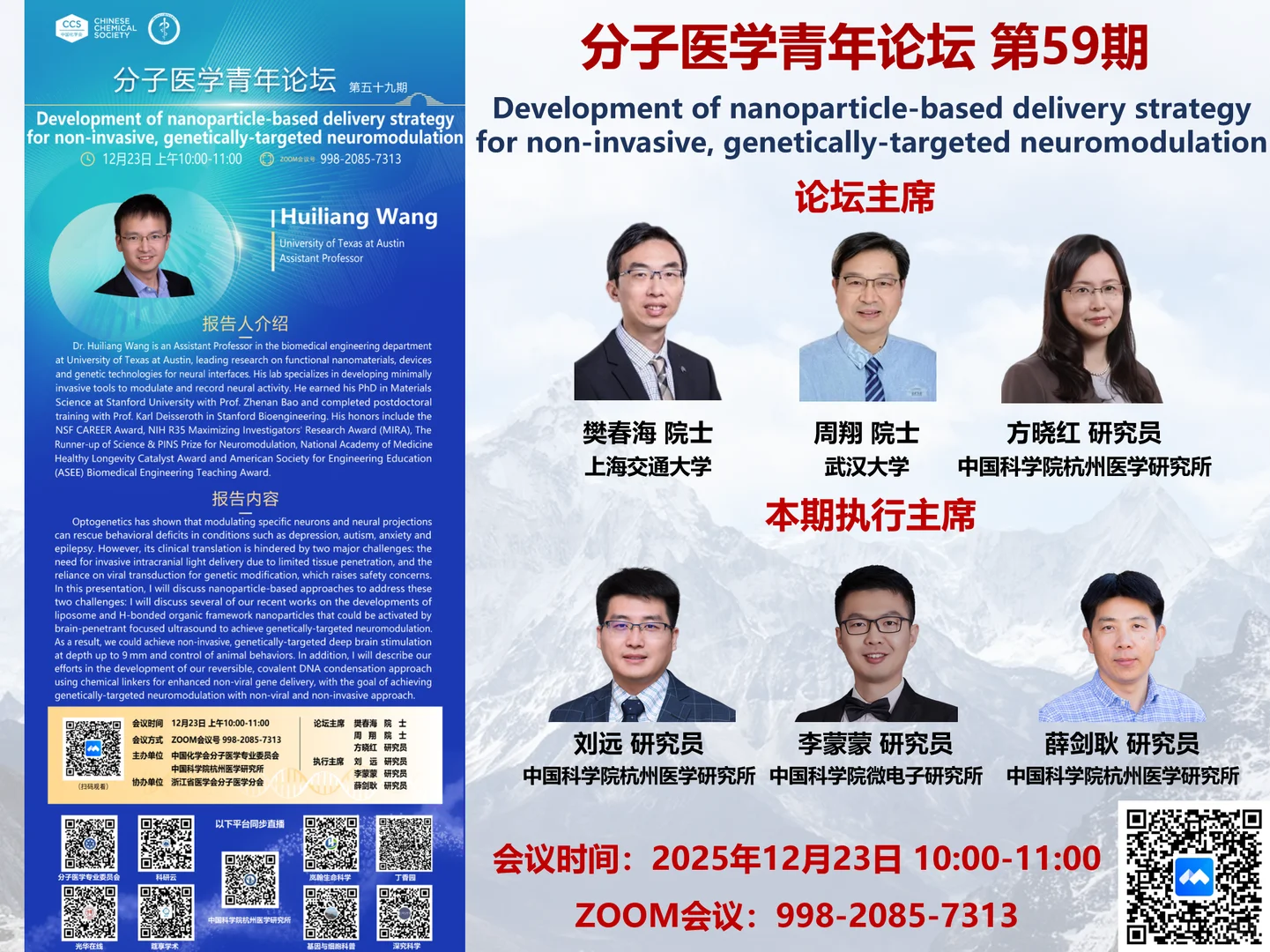
Optogenetics has shown that modulating specific neurons and neural projections can rescue behavioral deficits in conditions such as depression, autism, anxiety, and epilepsy. However, its clinical translation is hindered by two major challenges: the need for invasive intracranial light delivery due to limited tissue penetration, and the reliance on viral transduction for genetic modification, which raises safety concerns. In this presentation, I will discuss nanoparticle-based approaches to address these two challenges: I will discuss several of our recent works on the developments of liposome and H-bonded organic framework nanoparticles that could be activated by brain-penetrant focused ultrasound to achieve genetically-targeted neuromodulation. As a result, we could achieve non-invasive, genetically-targeted deep brain stimulation at depth up to 9 mm and control of animal behaviors. In addition, I will describe our efforts in the development of our reversible, covalent DNA condensation approach using chemical linkers for enhanced non-viral gene delivery, with the goal of achieving genetically-targeted neuromodulation with non-viral and non-invasive approach.
报告人简介:
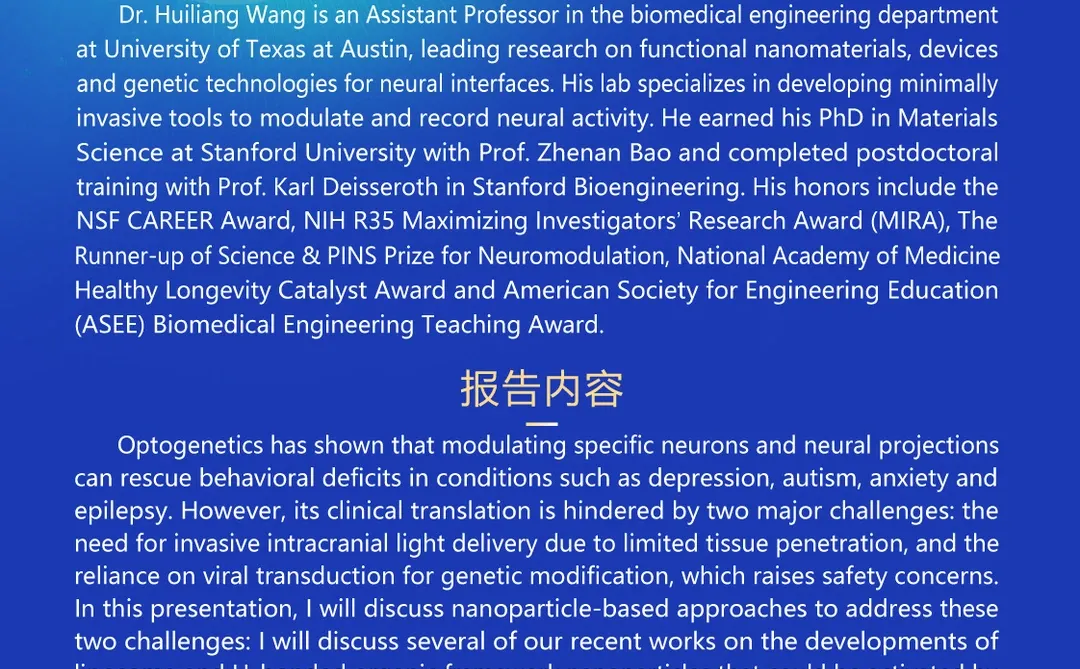
Dr. Huiliang Wang is an Assistant Professor in the biomedical engineering department at University of Texas at Austin, leading research on functional nanomaterials, devices, and genetic technologies for neural interfaces. His lab specializes in developing minimally invasive tools to modulate and record neural activity. He earned his PhD in Materials Science at Stanford University with Prof. Zhenan Bao and completed postdoctoral training with Prof. Karl Deisseroth in Stanford Bioengineering. His honors include NSF CAREER Award, NIH R35 Maximizing Investigators’ Research Award (MIRA), The Runner-up of Science & PINS Prize for Neuromodulation, National Academy of Medicine Healthy Longevity Catalyst Award and American Society for Engineering Educa
Optogenetics has shown that modulating specific neurons and neural projections can rescue behavioral deficits in conditions such as depression, autism, anxiety, and epilepsy. However, its clinical translation is hindered by two major challenges: the need for invasive intracranial light delivery due to limited tissue penetration, and the reliance on viral transduction for genetic modification, which raises safety concerns. In this presentation, I will discuss nanoparticle-based approaches to address these two challenges: I will discuss several of our recent works on the developments of liposome and H-bonded organic framework nanoparticles that could be activated by brain-penetrant focused ultrasound to achieve genetically-targeted neuromodulation. As a result, we could achieve non-invasive, genetically-targeted deep brain stimulation at depth up to 9 mm and control of animal behaviors. In addition, I will describe our efforts in the development of our reversible, covalent DNA condensation approach using chemical linkers for enhanced non-viral gene delivery, with the goal of achieving genetically-targeted neuromodulation with non-viral and non-invasive approach.
报告人简介:
Dr. Huiliang Wang is an Assistant Professor in the biomedical engineering department at University of Texas at Austin, leading research on functional nanomaterials, devices, and genetic technologies for neural interfaces. His lab specializes in developing minimally invasive tools to modulate and record neural activity. He earned his PhD in Materials Science at Stanford University with Prof. Zhenan Bao and completed postdoctoral training with Prof. Karl Deisseroth in Stanford Bioengineering. His honors include NSF CAREER Award, NIH R35 Maximizing Investigators’ Research Award (MIRA), The Runner-up of Science & PINS Prize for Neuromodulation, National Academy of Medicine Healthy Longevity Catalyst Award and American Society for Engineering Educa
