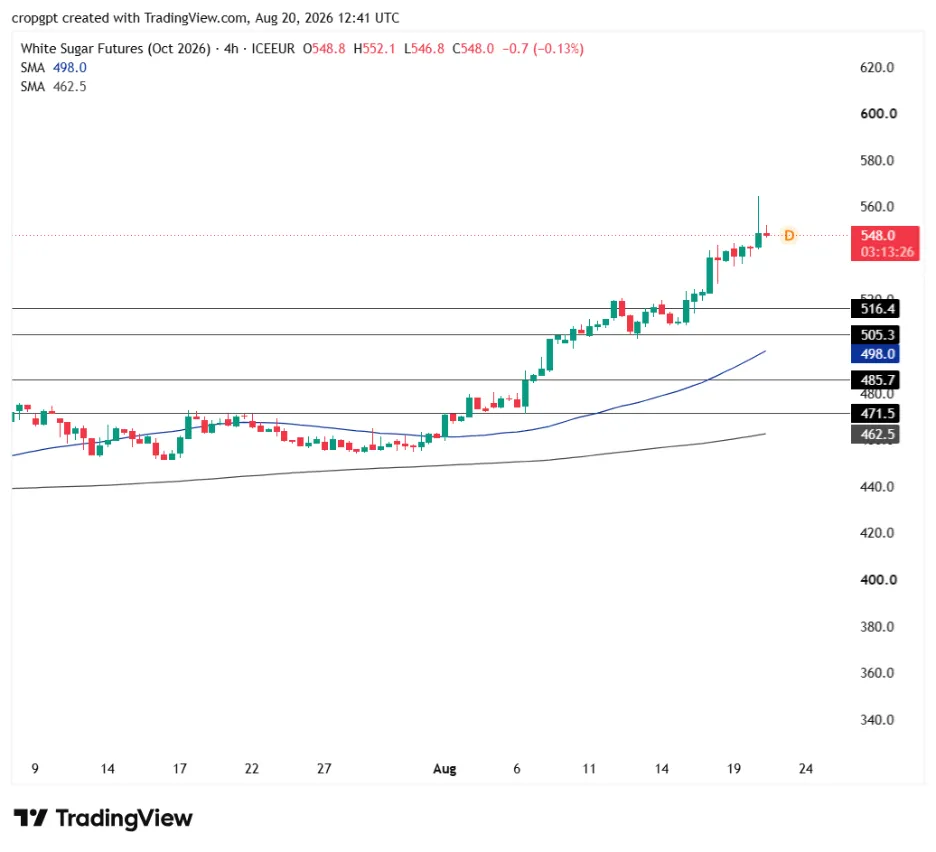
NY #11 and London White #5 both set fresh multi-month highs through Tuesday, at 15 and 16 months respectively, before a modest Wednesday pullback on profit-taking. October white sugar trades at $548.00 a tonne, down 70 cents on the session, after running from roughly $458 in late July to an intraday high near $560.
That is a gain of better than 22 per cent in three weeks. The move is not built on one origin. It is built on four failing at once.
The Forecaster Consensus Has Flipped
Five independent houses have revised the 2026/27 global balance toward deficit since May, and every revision has moved the same direction.
Green Pool cut to a deficit of 3.3 MMT on 29 July, from 1.76 MMT in June. StoneX moved to 1.7 MMT on 28 July, from 550,000 MT in May. Covrig swung to a 300,000 MT deficit on 3 August, having forecast a 100,000 MT surplus in June. Czarnikow shifted on 11 June from a 1.4 MMT surplus to a 100,000 MT deficit, citing Brazilian ethanol diversion. The ISO put the deficit at 262,000 MT on 18 May.
The range is wide, from 262,000 MT to 3.3 MMT. The direction is not. When five forecasters with different methodologies all revise the same way in the same quarter, the market treats it as information rather than noise.
Czarnikow has already looked a year further out, forecasting a 2.9 MMT deficit for 2027/28 on 15 August with global production falling 0.7 per cent to 177 MMT.
Four Origins, Four Problems
Brazil is diverting cane. Unica reported Center-South sugar production of 3.903 MMT for June, down 26.3 per cent year on year. Conab's initial 2026/27 forecast has ethanol output rising 7.2 per cent to 29.259 million litres while sugar falls 0.5 per cent to 43.952 MMT. The crude oil surge tied to the US-Iran war has widened the ethanol margin, and mills respond to margins.
India has a rainfall problem and is considering a policy response that would be remarkable. Cumulative monsoon rainfall stood 13 per cent below normal on 19 August. That is a real recovery from the 42 per cent deficit recorded on 30 June, and it is the strongest argument the bears have. But the IMD forecast on 31 July that August and September rainfall will likely stay below normal, and the Earth Science Ministry has warned this could be the weakest monsoon in 11 years.
Bloomberg reported on 19 August that New Delhi is actively considering cutting sugar import duties ahead of festival season. India is normally a net exporter. The last substantial import programme was 2017/18. A government even weighing that step is a supply signal in itself, regardless of whether the duty cut lands.
ISMA had already trimmed 2025/26 Indian production to 32 MMT from 32.4 MMT back in April, with exports projected at only 800,000 MT.
Europe is the quiet one. S&P Global data puts combined EU and UK 2026 production at 14.98 MMT, the lowest in 11 years, after drought and heat across the beet belt. That tightens the white sugar balance directly, independent of anything happening in raw.
Thailand completes the set. The USDA FAS forecast 2026/27 output falling 15.6 per cent to 9.5 MMT. The US Climate Prediction Center assessed on 8 July that the emerging El Niño may rank among the strongest in more than 75 years, and the pattern brings warmer, drier conditions to Brazil, India and Thailand at the same time. Those are the three largest producers in the world.
The Bear Case Rests on the USDA
The counterargument is worth taking seriously because it comes from the largest forecaster and it points the opposite way.
The USDA projected on 30 April that India would run a 2.5 MMT surplus in 2026/27, its first in two years. The FAS forecast Indian production rising 12 per cent to 33.6 MMT on favourable monsoon rains and expanded acreage. The May biannual report had global ending stocks rising 2.0 per cent to 44.410 MMT even with production falling, on softer consumption assumptions.
Set that against a monsoon running 13 per cent below normal and a government contemplating imports. Those two pictures cannot both be right. The market has chosen, and the USDA's next revision is now the single most consequential number on the calendar.