A recovering Indian monsoon has triggered profit-taking after recent highs, although ethanol economics and El Niño risks continue to support the longer-term balance.
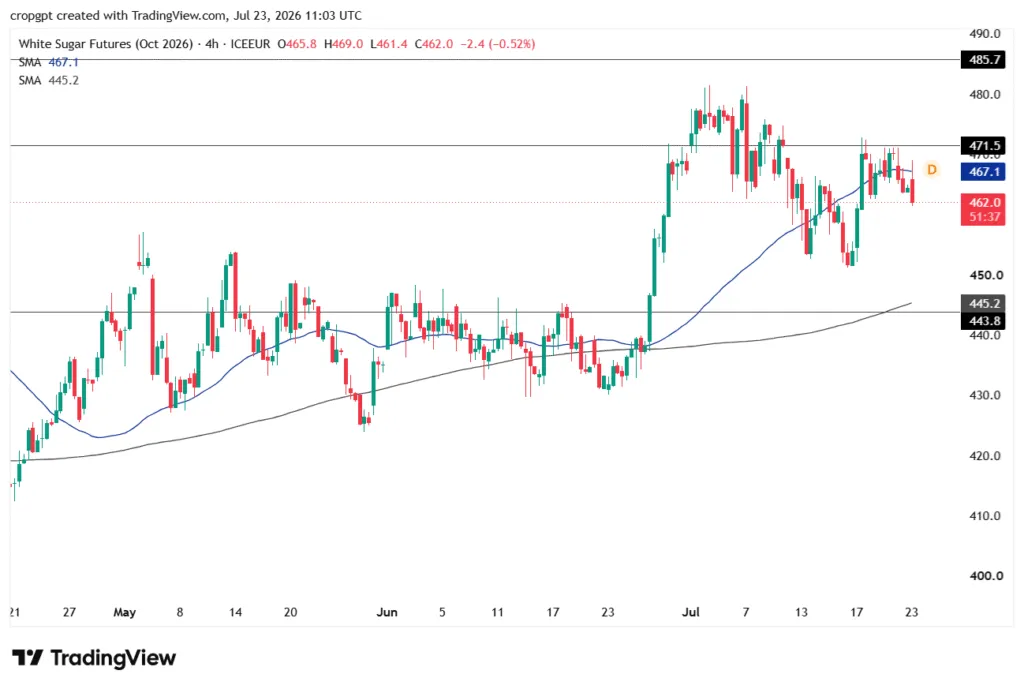
Sugar prices corrected lower this week, with October NY world sugar #11 (SBV26) and October London ICE white sugar #5 (SWV26) closing down 0.13 percent and 0.57 percent on Monday, up 0.40 percent and 0.45 percent on Tuesday, and down 0.94 percent and 0.98 percent on Wednesday. The pullback follows a sharp rally that carried NY sugar to a two and a quarter month high on July 8 and London white sugar to a ten and a half month high on July 7, and comes as India's monsoon rainfall deficit has narrowed meaningfully, easing near-term concerns over crop losses in the world's largest sugar producing nation.
Declines were cushioned mid to late week by a rally in WTI crude oil, which strengthens ethanol economics and encourages mills to divert cane crushing away from sugar production. A record net-long position among funds in ICE London white sugar adds downside risk should the current correction extend further. Structurally, the market remains supported by El Niño driven dryness concerns across Brazil, India and Thailand, and by a widely cited shift toward ethanol production in Brazil that is expected to tighten the 2026/27 global sugar balance.
An Improving Monsoon Meets a Record Fund Long, Setting Up a Two-Sided Market
India's Meteorological Department reported cumulative monsoon rainfall at 19 percent below normal as of July 22, an improvement from 23 percent below normal on July 20 and 42 percent below normal on June 30. The steady narrowing of that deficit has undercut the crop-loss premium that had been building into prices through early July. At the same time, CFTC and ICE Commitment of Traders data for the week ended July 14 showed funds increased net-long positions in ICE London white sugar by 716 contracts to a record 58,847, the highest in a data series stretching back to 2011. That positioning leaves the market exposed to further long liquidation if the monsoon recovery continues, a dynamic that helps explain why this week's correction has had more force than the underlying fundamental shift might otherwise suggest. Separately, the International Sugar Organization forecast on May 18 record 2025/26 global production of 182 million tonnes, up 3.5 percent year on year, and raised its 2025/26 global surplus estimate to 2.2 million tonnes from a February estimate of 1.22 million tonnes, a marked swing from the 3.46 million tonne deficit recorded in 2024/25.
Crude Oil Strength and Brazilian Ethanol Diversion Keep the 2026/27 Balance Tightening
WTI crude oil rose more than 2 percent to a five week high on Tuesday and a six week high on Wednesday, boosting ethanol prices and reinforcing the incentive for Brazilian mills to direct cane toward ethanol rather than sugar. Unica reported on June 22 that 2026/27 Brazil Center-South sugar production through May stood at 6.838 million tonnes, down 2.0 percent year on year, as the share of cane allocated to sugar fell to 41.42 percent from 50.09 percent while the ethanol crush share rose to 58.38 percent from 49.91 percent a year earlier. That shift is showing up across forecaster models. Czarnikow cut its 2026/27 global sugar balance estimate on June 11 from a surplus of 1.4 million tonnes to a deficit of 100,000 tonnes, citing Brazilian mills' pivot toward ethanol amid higher crude prices. The ISO's May 18 outlook pointed the same way, forecasting 2026/27 production down 1.15 percent year on year to 180 million tonnes and a global deficit of 262,000 tonnes, citing El Niño risk to India and Thailand. StoneX forecast a 2026/27 deficit of 550,000 tonnes on May 20, while Covrig Analytics cut its 2026/27 surplus forecast to 100,000 tonnes from a prior 380,000 tonnes. The US Climate Prediction Center warned on July 8 that the emerging El Niño pattern is likely to be one of the strongest in more than 75 years, threatening rainfall across Brazil, India and Thailand, the world's three largest producers, while Conab and USDA FAS have both trimmed Brazilian and Thai production estimates for 2026/27.