

2026年3月,世界经济论坛(WEF)联合埃森哲发布了一份重磅白皮书《Organizational Transformation in the Age of AI: How Organizations Maximize AI's Potential(AI时代的组织转型:企业如何最大化释放AI的潜力)》。
报告核心结论总结为一句话是:
全球只有约15%的企业在真正用AI重新设计工作方式。剩下85%,做了很多,效果出不来。
报告调研了全球450多位企业高管,覆盖客户体验、运营、研发、战略规划、人才管理五个核心领域,提出一个观点:将来有企业掉队,并不是AI不行,是组织变革没跟上。
"Those that do not risk falling behind – not because AI fails them, but because organizational change does."
报告的执行摘要里有一句定调的话,指出目前企业AI转型最大的命题:
"The central challenge has shifted: not whether AI works, but how organizations must change to realize its full, sustained value."
核心挑战已经变了:不是AI到底有没有用,而是组织要怎么变,才能把AI的价值真正、持续地兑现出来。
今天这篇文章,我们就来拆解报告中提到的,那15%的领先者,到底做对了什么。
答案分为三个层面:三个贯穿性的结构性转变、五个重点领域的各自转变、五条组织原则。
领先者正在经历的三个结构性转变
报告在执行摘要里明确写了"三个结构性转变",这既是报告的核心框架,也是五个领域的共同主线:
转变1:从孤立用例,到互联系统
"From isolated use cases to connected systems, where customer experience (CX), operations, research and development (R&D), strategy and talent reinforce one another"
大多数企业AI的应用方式是"孤岛化"的:客服用客服的,运营用运营的,数据不通,互相割裂。领先者在做的,是让AI在整条价值链上跑通:客户体验、运营、研发、战略、人才,五个领域的数据互通、互相强化。不是给部门装AI,是给整条价值链装一个共享大脑。
转变2:从周期性项目,到持续流程
"From episodic initiatives to continuous processes that sense signals, make decisions and learn in real time"
大多数企业把AI转型当"项目"做,基本是按照项目节奏来,从立项、验收、结项。领先者对AI的定位是:让AI变成组织的日常运行逻辑,实时感知信号、实时做决策、实时学习,24小时不停。
转变3:从任务自动化,到人类价值创造
"From task automation to human value creation, with people focusing on judgement, orchestration and accountability while AI accelerates insight and execution"
大多数企业用AI,首先想到的是为了减少人力、降低成本。领先者会更注重把AI和人进行分工。AI处理执行层面的事,人专注判断、编排、问责。人的价值不在于"做",在于"决定做什么"。
这三个转变的关系是这样的:转变1讲"连起来",打破孤岛;转变2讲"动起来",不是按日程做事,是按实际需要动;转变3讲"人升维",AI把地面的活干了,人站到高处掌舵。
理解了这三个转变,再去看五个领域,就知道它们不是孤立的,都在指向同一个方向。
领先企业在做什么:五个重点领域
报告原文叫"Focus Areas",五个领域都有四个具体的转变。
01 | 客户体验:从静态旅程到实时意图驱动
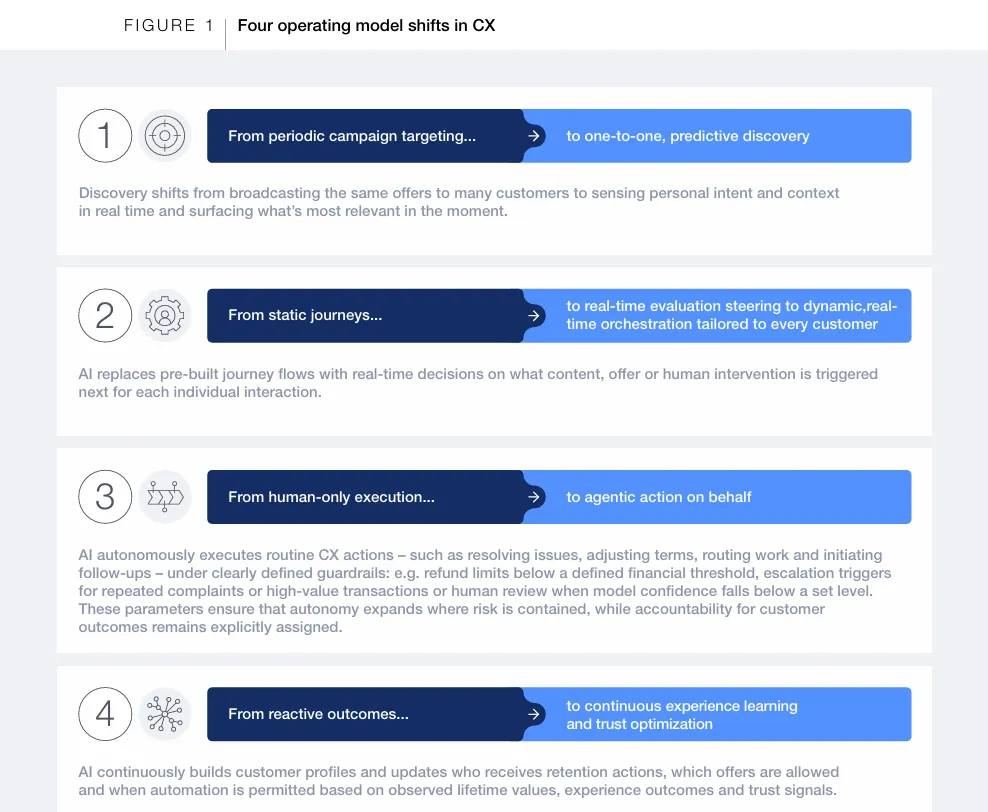
CX领域的本质变化是:从"我有什么给你推什么"变成"你需要什么我主动给你什么"。
报告原文:
"AI turns customer journeys into real-time, adaptive systems that predict intent, act autonomously and learn continuously."
转变1:从按节奏推,到实时判断
"Discovery shifts from broadcasting the same offers to many customers to sensing personal intent and context in real time and surfacing what's most relevant in the moment."
过去按节奏推,比如这周发优惠券,下周上新推荐。AI把它变成实时判断:这个人现在需要什么、会不会流失、要不要触达。
转变2:从静态剧本,到实时路况导航
"AI replaces pre-built journey flows with real-time decisions on what content, offer or human intervention is triggered next for each individual interaction."
过去客户旅程是预设好的剧本,问题是客户不会按你的剧本走。AI让旅程变成"实时路况导航",系统持续解读行为信号,动态决定下一步推什么。
转变3:从纯人执行,到AI直接执行
"AI autonomously executes routine CX actions – such as resolving issues, adjusting terms, routing work and initiating follow-ups – under clearly defined guardrails."
AI可以直接帮客户完成操作:比如自动退款、自动改期、自动续费。
不过也需要设定阈值,风险可控的地方,自主权放大;但不管AI跑多远,最终对客户结果负责的,永远是人。
"autonomy expands where risk is contained, while accountability for customer outcomes remains explicitly assigned."
转变4:从事后反应,到持续体验学习和信任优化
"AI continuously builds customer profiles and updates who receives retention actions, which offers are allowed and when automation is permitted based on observed lifetime values, experience outcomes and trust signals."
信任成了可以实时调控的系统变量:信任高,多自动化,信任降了就收一收。不是事后看报表,而是过程中动态调整。
代表案例:
福特用了AI决策引擎系统,在三周内触达超30万车主客户,转化率提升了26%。
荷兰的Rabobank银行部署了Customer Decision Hub,实现每年15亿次个性化互动,点击率提升4倍,转化率上涨208%,客户终身价值提升4.7%,单客服务成本反而降了2.4%。
02 | 运营体系:从预测驱动到自适应编排
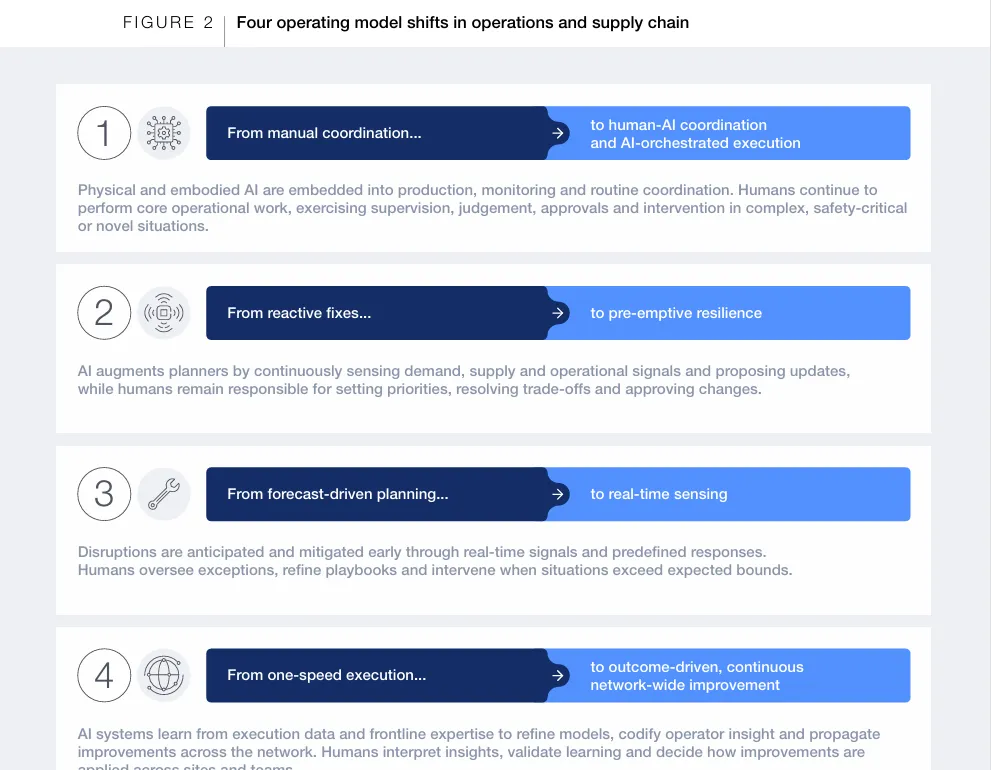
运营领域的核心变化是:AI不是帮你做更好的预测,而是让"预测"这件事本身变得不再重要。“故障可以提前被看见了”。
报告原文:
"AI introduces a fundamentally different architecture across this value chain. By embedding real-time sensing and predictive intelligence into execution, it enables operations to shift from reactive, scheduled execution to adaptive, predictive and learning-based systems."
具体也有四个转变:
转变1:从人工协调,到人机协同+AI编排执行
"Physical and embodied AI are embedded into production, monitoring and routine coordination. Humans continue to perform core operational work, exercising supervision, judgement, approvals and intervention in complex, safety-critical or novel situations."
产线参数不行了,系统自己调。设备该修了,工单自己派。人从调度员变成了监督员。
转变2:从坏了再修,到问题还没发生就拦截
"AI augments planners by continuously sensing demand, supply and operational signals and proposing updates, while humans remain responsible for setting priorities, resolving trade-offs and approving changes."
现在AI持续监测温度、振动、电流信号,故障发生前就察觉异常。
关键是这个洞察:"波动不再是'需要消灭的偏差',而是'需要解读的信号'。"
转变3:从预测驱动规划,到实时感知
"Disruptions are anticipated and mitigated early through real-time signals and predefined responses. Humans oversee exceptions, refine playbooks and intervene when situations exceed expected bounds."
传统供应链靠预测驱动,先猜下个月需求,再据此采购。AI让运营变成"实时感知+动态响应",今天需求涨了就加产能,物流断了就自动切换线路。
转变4:从单一速度执行,到结果驱动的持续网络级改善
"AI systems learn from execution data and frontline expertise to refine models, codify operator insight and propagate improvements across the network."
一个工厂跑出来的最优解,被AI提取验证后,自动同步到相似产线,不是"搞一次改善项目",而是持续迭代优化。
代表案例
联想把AI Agent"iChain"嵌入全球供应链核心,实时监测需求、供应商约束和物流状态,动态调整,出货准确率提升30%。
Nestlé Purina用AI机器人在工厂巡检,搭载热感和声学传感器,持续扫描马达和变速箱,问题在被"看见"之前就拦截了,非计划停机显著减少。
Allied Systems跨多个站点部署AI代理人,设备综合效率提升了10%,原材料和能源浪费同步下降。
03 | 研发创新:从线性执行到持续学习引擎
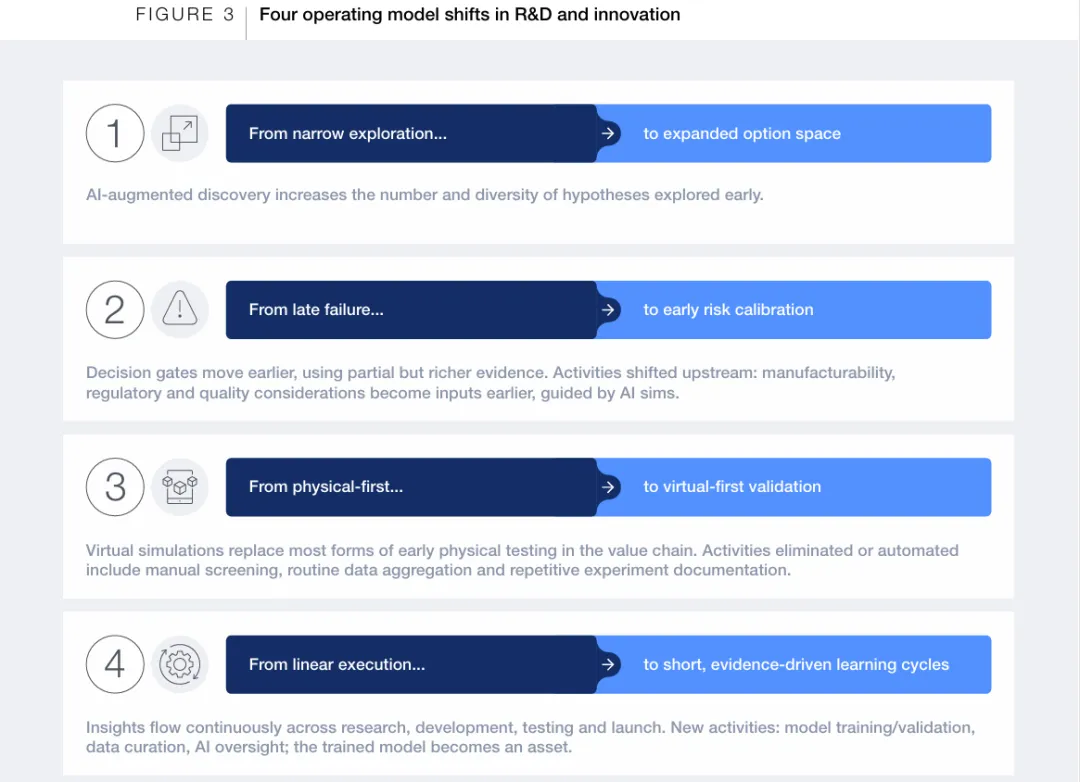
报告引了一组数据:近40%的高管把研发列为AI回报最大的领域。为什么?因为研发的痛最痛:慢、贵、不确定。
报告原文:
"AI transforms R&D by turning linear execution into continuous learning, expanding the range of options explored and shifting risk assessment from late failure to early calibration."
转变1:从窄域探索,到扩展选项空间
"AI-augmented discovery increases the number and diversity of hypotheses explored early."
AI在极短时间内生成海量候选方案,几亿个分子结构、几千种设计变体,自动筛出最有可能的几个推到人面前。人的角色从"海里捞针"变成"盘子里挑针"。
转变2:从晚期才发现不行,到早期就预判风险
"Decision gates move earlier, using partial but richer evidence. Activities shifted upstream: manufacturability, regulatory and quality considerations become inputs earlier, guided by AI sims."
AI在项目概念阶段就用多维度数据做预判,差的方案在烧钱前被终止。以前是"试试看,不行再说",现在是"在投入大量资源之前就知道行不行"。
转变3:从先做物理实验,到先在虚拟里跑通
"Virtual simulations replace most forms of early physical testing in the value chain."
先上仿真、数字孪生、虚拟实验室,筛出最优解后才进物理测试。物理实验从"试错工具"变成"验证工具"。
转变4:从线性流程,到短周期闭环
"Insights flow continuously across research, development, testing and launch. New activities: model training/validation, data curation, AI oversight; the trained model becomes an asset."
不再是"一条路走到黑",而是"试验-学习-调整"的短循环,AI模型本身就是企业资产,越用越聪明。
代表案例
德国默克用AI药物发现平台AIDDISON™,虚拟筛选超过600亿个潜在化学靶点,从猜想到确定可行分子的时间和成本直降70%。
丹麦灵北制药构建头痛疾病知识图谱,整合5400万份电子病历和基因数据,新药靶点发现速度提升80%。
英国的Ignota Labs专门捡大药厂因毒性扔掉的项目,用AI重新分析、重新设计,返回临床试验不到2年、花费不到100万美元,传统路子要7到8年、1000万美元。
04 | 战略规划:从年度计划到持续纠偏
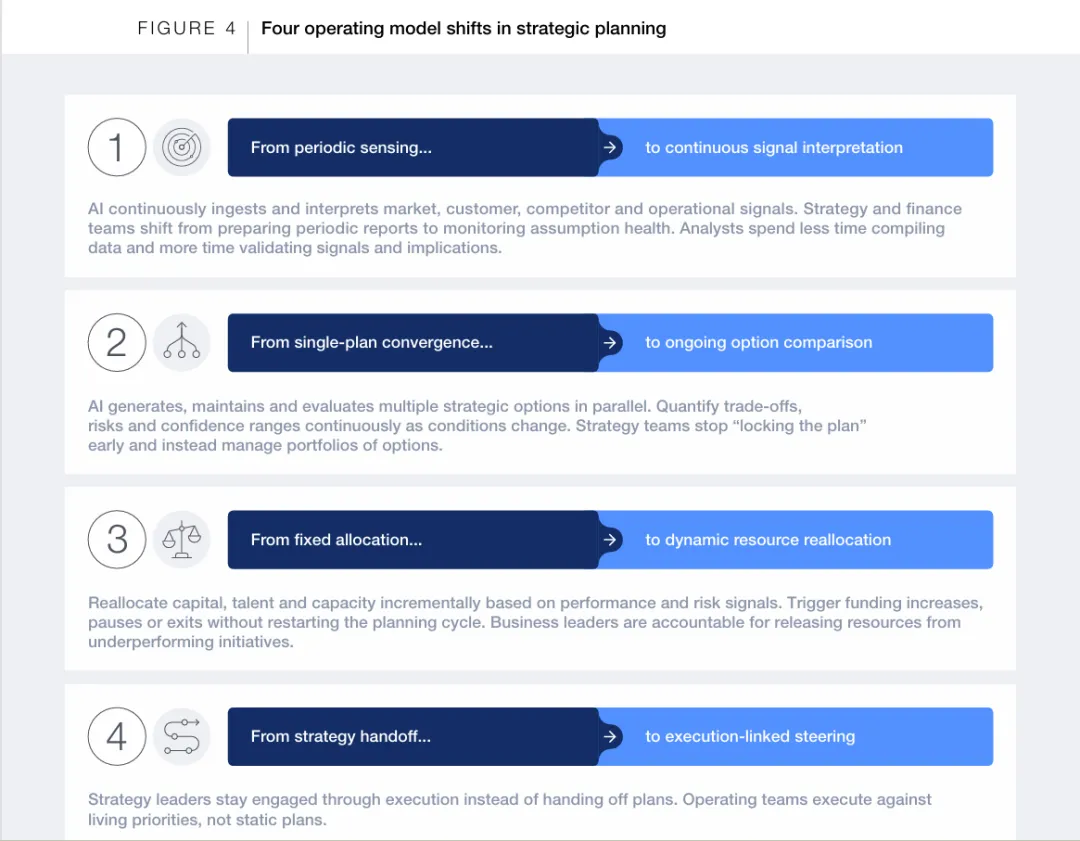
这个领域的转变最反直觉,AI不是帮你做更好的年度计划,是让"年度计划"这个概念本身变得过时。
报告原文:
"AI turns strategic planning into a 'living' process by continuously sensing signals, testing assumptions and linking decisions to execution."
转变1:从定期看报表,到持续解读信号
"AI continuously ingests and interprets market, customer, competitor and operational signals. Strategy and finance teams shift from preparing periodic reports to monitoring assumption health."
不再依赖季度报告。分析师花更少时间汇编数据,更多时间验证信号及其影响。
转变2:从锁定一个计划,到维护动态选项组合
"AI generates, maintains and evaluates multiple strategic options in parallel. Quantify trade-offs, risks and confidence ranges continuously as conditions change."
策略团队不再"锁定"一个计划,而是管理一个动态的"选项组合"。市场变了,选项跟着变。
转变3:从固定分配,到动态资源再分配
"Reallocate capital, talent and capacity incrementally based on performance and risk signals. Trigger funding increases, pauses or exits without restarting the planning cycle."
不行项目不等下个周期,立刻叫停或转向。业务负责人有责任从表现不佳的项目中释放资源。
转变4:从战略交接,到执行联动纠偏
"Strategy leaders stay engaged through execution instead of handing off plans. Operating teams execute against living priorities, not static plans."
战略制定者持续参与执行过程,根据最新信号联动调整。
代表案例:
Canada Goose用AI场景规划,规划周期缩短60%,收入预测准确率提升4%。不是计划更准了,是计划变成了一个"活着的东西"。
S&P Global用AI分析了超过19万份财报电话会议录音,从高管怎么回答分析师问题里,提取出能预测市场走向的前瞻性信号。
05 | 人才管理:从岗位管理到能力系统
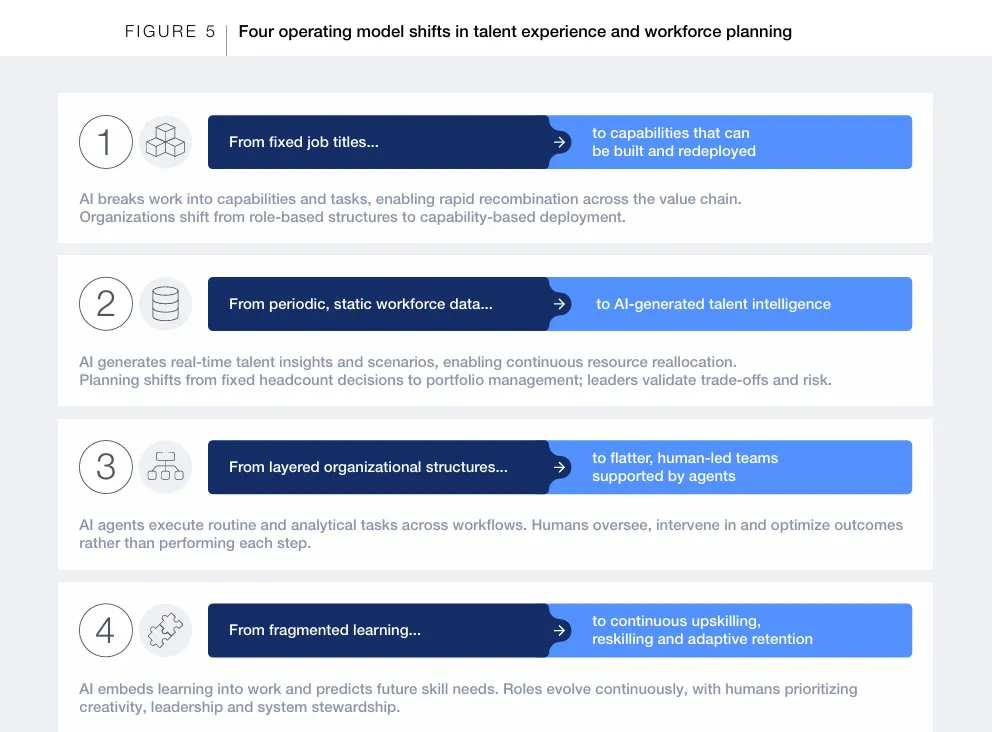
报告原文:
"AI shifts talent and workforce planning from a role-based HR function to a continuous capability system that aligns human and digital capacity with evolving work and priorities."
从"岗位"到"能力",这不是HR术语的变化,是组织运行逻辑的底层切换。
转变1:从固定岗位,到可构建可重部署的能力
"AI breaks work into capabilities and tasks, enabling rapid recombination across the value chain. Organizations shift from role-based structures to capability-based deployment."
岗位不再是固定盒子,而是一堆可以随时拆开、重新组合的能力积木。
转变2:从周期性静态人力数据,到AI生成的人才智能
"AI generates real-time talent insights and scenarios, enabling continuous resource reallocation. Planning shifts from fixed headcount decisions to portfolio management."
过去人才盘点一年做一次。AI把人才数据变成实时情报,持续整合技能、项目经历、绩效趋势,管理者随时能看到哪里有空缺。
转变3:从层级结构,到扁平化、人主导+Agent支持的团队
"AI agents execute routine and analytical tasks across workflows. Humans oversee, intervene in and optimize outcomes rather than performing each step."
组织从金字塔变成更扁平的团队形态。但决策和方向仍然由人主导,也就是human-led,不是AI-led。
转变4:从碎片化学习,到持续技能提升和适应性留任
"AI embeds learning into work and predicts future skill needs. Roles evolve continuously, with humans prioritizing creativity, leadership and system stewardship."
学习不再"脱产上课",AI预测你接下来需要什么能力,即时把知识、案例、专家推到你面前。学习长在业务上,不是额外负担。
代表案例:
联合利华搭建了AI驱动的内部人才市场,员工根据技能和发展目标匹配短期项目。70%的任务来自跨职能分配,释放了50万小时人力产能,生产力提升41%。
强生用AI推断员工在41项"面向未来的关键技能"上的熟练度,领导者拿着"技能热力图",按业务线和地区看哪里该内部培养、哪里该从外面招。效果立竿见影:学习平台活跃度提升20%,90%的技术人员都上了平台。
百胜中国用AI招聘平台服务全国超16000家门店,NLP算法匹配海量候选人、大模型分析面试给出建议,约89%的餐厅招聘需求由系统完成,店长离职率从9.7%降到7.8%。
领先者共同做对的五件事
五个领域讲完了。但"在做什么"只是表面。真正的问题是:为什么有些企业做到了,大多数企业没有?
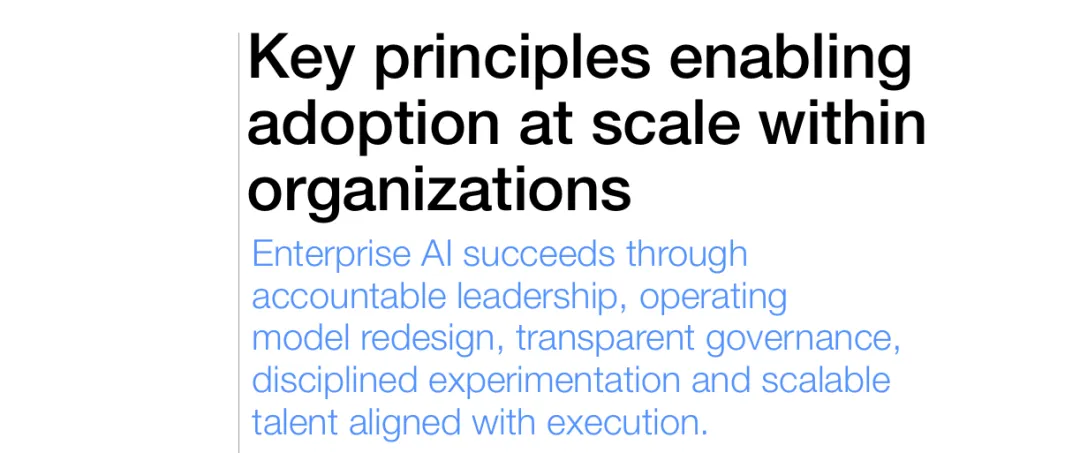
报告提炼了五个组织原则,原文叫"Key principles enabling adoption at scale",这是15%和85%之间的真正分水岭。
原则1:人类问责制,从"人在环中"到"人为主导"
"Moving from 'human-in-the-loop' to 'human-in-the-lead' means clearly defining decision ownership, autonomy thresholds and escalation paths before, during and after deployment at scale."
AI建议调一批货,你签了,结果错了,谁负责?罚不着AI。很多企业用不好AI就卡在这儿:要么没人签字,AI晾在那白瞎了;要么都说"AI说的",责任推得干干净净。
领先企业把这条焊死了:就算AI跑得再快,最终按按钮的永远是人。这个人知道出了事是自己扛。 不只是文化层面,是写进了权责体系和绩效考核里的。
"While AI informs decisions, accountability for outcomes remains with people, and leadership ownership is essential to building confidence and adoption."
原则2:端到端运营模式重新设计,换操作系统,不是打补丁
"Without operating model redesign, AI amplifies complexity – with it, AI simplifies how value flows through the enterprise."
你给马车装再好的发动机,它也跑不成汽车。问题是很多企业就是在给马车装发动机——旧流程上这儿塞一句AI,那儿加一个工具。结果不是更顺畅,是更碎更乱了。
"Scaling AI requires more than expanding pilots or automating individual tasks. Organizations that achieve enterprise impact redesign operating models around shared, end-to-end outcomes."
领先者做的是直接换操作系统:围绕价值是怎么流经企业的,重新设计工作的组织方式。
原则3:可规模化的人才体系,不是精英特训,是全员武装
"At scale, technology is rarely the limiting factor. People, incentives and ways of working determine whether AI delivers sustained value."
它们不是在办"AI培训班",下了课员工回旧流程里继续干活。而是把能力嵌入日常工作流,学在做中,做在学中,不是额外负担。
"Leading organizations invest deliberately in scalable talent systems and treat change as a permanent capability."
原则4:透明驱动的信任,不是合规要求,是规模化的前提
"Transparency-driven trust ensures AI decisions are explainable and trustworthy to all stakeholders."
当业务人员不理解AI为什么给了一个建议,他会:不信任,按自己经验做判断;用错了,把失误当借口。然后组织里就开始有人抱怨"AI不行",不是因为AI真的不行,是因为它没被正确使用。
原则5:纪律化的实验,不是创新口号,是执行纪律
"Leading organizations treat experimentation as an execution discipline, not an innovation exception. They design AI-enabled workflows to experiment continuously, absorb small failures safely and translate learning into improved workflows and decisions."
领先者骨子里接受了AI会犯错。但它们把犯错控制在安全范围内,小范围、低成本、可复原。错一次,学到教训,全系统进化一份。
"Failures are expected, contained and informative. Autonomy thresholds, decision policies and escalation rules are adjusted based on real-world performance rather than theoretical assumptions."
大多数公司呢?文化上不允许犯一点错,结果没人敢做新实验,大家一起躺平。
最后
如果要把这份报告浓缩成一句话:
AI转型的分水岭,不是技术差距,是"你有没有准备好重构组织运行逻辑"。
过去比的是谁先接入模型。接下来比的,是谁先完成组织重写。
用报告结语里收尾的话作为今天文章的收尾:
"Those that do not risk falling behind – not because AI fails them, but because organizational change does."
你落后的原因,不会是AI不行,而是你的组织没变。
如果内容对你有启发,欢迎点赞、在看或分享给志同道合的朋友。我是林潼,专注AI时代的组织演化与个人角色升级。在这里,一起进化为掌控未来的超级个体。欢迎关注我。
后台回复20260506,即可获取原文报告。